

From admit to graduation: How the University of Montana centralized *student* communications in CampusESP
Today’s students are bombarded with emails from every corner of campus — the president, advising, health services, student affairs, and more. When everything is urgent, nothing stands out. And students start ignoring it all.
At the University of Montana, students historically received communication through Slate during admissions. But once they enrolled, a flood of daily emails from departments across campus took over.
When tasked with centralizing student communication into a more personalized, intentional experience, Devin Carpenter , the Director of New Student Success, saw an opportunity to rethink how students engage with campus information — and turned to CampusESP.
Six months later, the UM team has reduced noise, built consistency, and created a system students actually use — scaling across the entire student lifecycle.

“CampusESP works for families. Can we use it for students too?”
The University of Montana has been using CampusESP for Student Enrollment and Family Communication since 2021 to communicate with prospective and current family members.
In 2025, the Office for New Student Success undertook a campus-wide presidential initiative to centralize and restructure all student communications to focus and align their initiatives, cut down on student email fatigue, and boost retention.
UM already trusted CampusESP for families, so extending it to students wasn’t a leap, it was a natural evolution.
During their 4-week implementation, they worked with the CampusESP team to build a personalized student experience (called The Sentinel), using tools like:
Onboarding surveys to ask students what information they want to receive to immediately personalize their experience
Communities to segment communication so students only receive information relevant to their interests and identity, reducing noise and improving engagement.
Automated newsletters to summarize the information students are interested in to and give students a predictable communication rhythm
Emails to supplement automated newsletters, with timely reminders
Student-focused branding to make a student experience they could rely on that was distinct from the family experience
Student Single Sign-On to make access easy and consistent
Automated student imports to automatically import new students at the start of each semester
Mobile student experience to meet students where they are - on their phones!
Text messaging to get important information out to students in the way they prefer
Performance Dashboards and flexible data reporting to make sure the content was landing and students were responding well to a new initiative
By using all these tools in tandem, UM has successfully transitioned to more personalization and segmentation in a one-stop-shop for student communication.
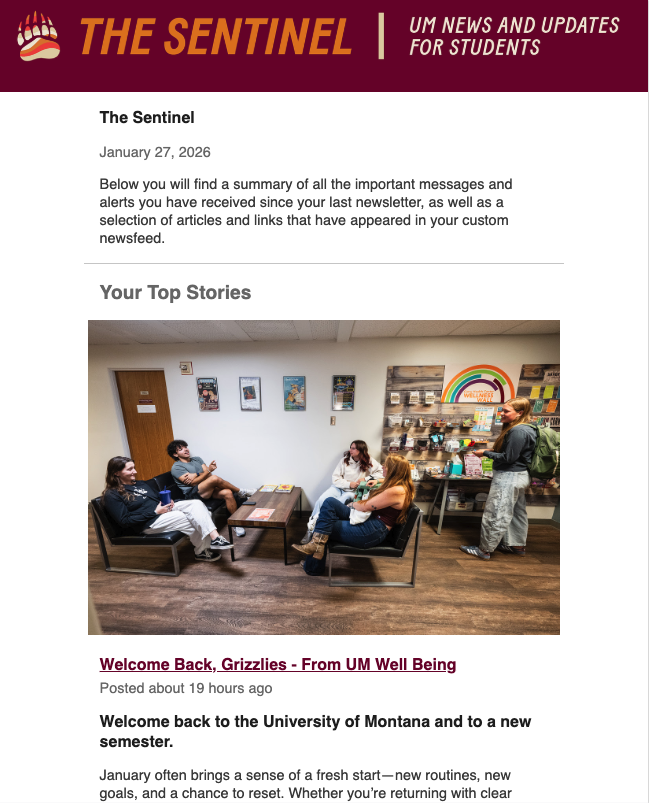
Early results from The Sentinel
6 months in, early results for enrolled students are promising.
7,500 enrolled UM students have accounts in CampusESP with new students being imported each new semester
Over 6,500 students have actively used CampusESP over the last 6 months, engaging with emails or the online student experience
Positive engagement with email and online content, with over 6,000 clicks on content
Encouraging student feedback: student focus groups revealed that students trust CampusESP’s emails, newsletters, and portal experience as a go-to source for up-to-date and accurate information from the university
Engagement is highest around critical success topics like class registration and using health insurance on campus, further proof that essential information is reaching students.
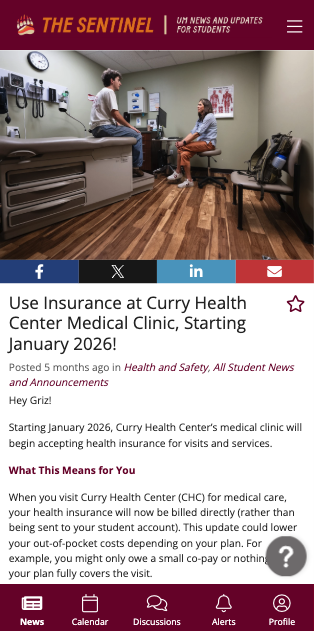
“Students are responding really well to CampusESP. We’re seeing strong engagement with topics that we know matter most to their success, like course registration, and we’re hearing from them that ‘The Sentinel,’ as we call it, is becoming a recognizable source for important information”
Iterating for the best student experience: What’s next for The Sentinel?
Once enrolled students were successfully centralized in CampusESP, the UM team faced a bigger question: If this is where students will live for the next four years… why not get them started here?
Orientation was the natural starting point. Historically, admitted students registered for the Big Sky Experience, UM’s welcome week style orientation program, through Slate.
Now, using CampusESP for Student Orientation, all admitted students will be imported and begin receiving nudges to register for their Big Sky Experience through CampusESP, setting them upin the same place they’ll receive reminders, resources, and ongoing communication as full-on Grizzlies.
Orientation isn’t a one-time event - it’s the entry point into a consistent, centralized student experience.
Carpenter shared the importance of this transition: "By getting students registered for their Big Sky Experience in CampusESP when they're most excited about UM, we'll be able to collect their interests and needs during that first step of the student journey. We're excited about the doors this opens to tailor and personalize their communications from us right from the start!"
The Office for New Student Success is looking forward to finishing out a full year using CampusESP for Student Orientation and Communication in the coming months, and plans to continue accessing the impact of consolidated student communication on student success, transitions, and retention.
Ready to streamline your student communications?
CampusESP is beta testing CampusESP for Student Communication. If you’re interested in exploring the opportunity, reach out to our Product Team at product@campusesp.com!