

New research: Family engagement drives student retention

For years, family engagement has lived in the “good idea” category.
Important. Helpful.
But optional.
New institutional research from the University of Alabama at Birmingham (UAB) suggests something different:
Moderate and high levels of family engagement are significantly associated with increased freshman retention — even after controlling for GPA and demographic factors.
The study: 1,891 first-time, full-time freshmen
UAB’s Office of Institutional Effectiveness & Analysis conducted an exploratory study of 1,891 first-time, full-time freshmen entering in Fall 2023.
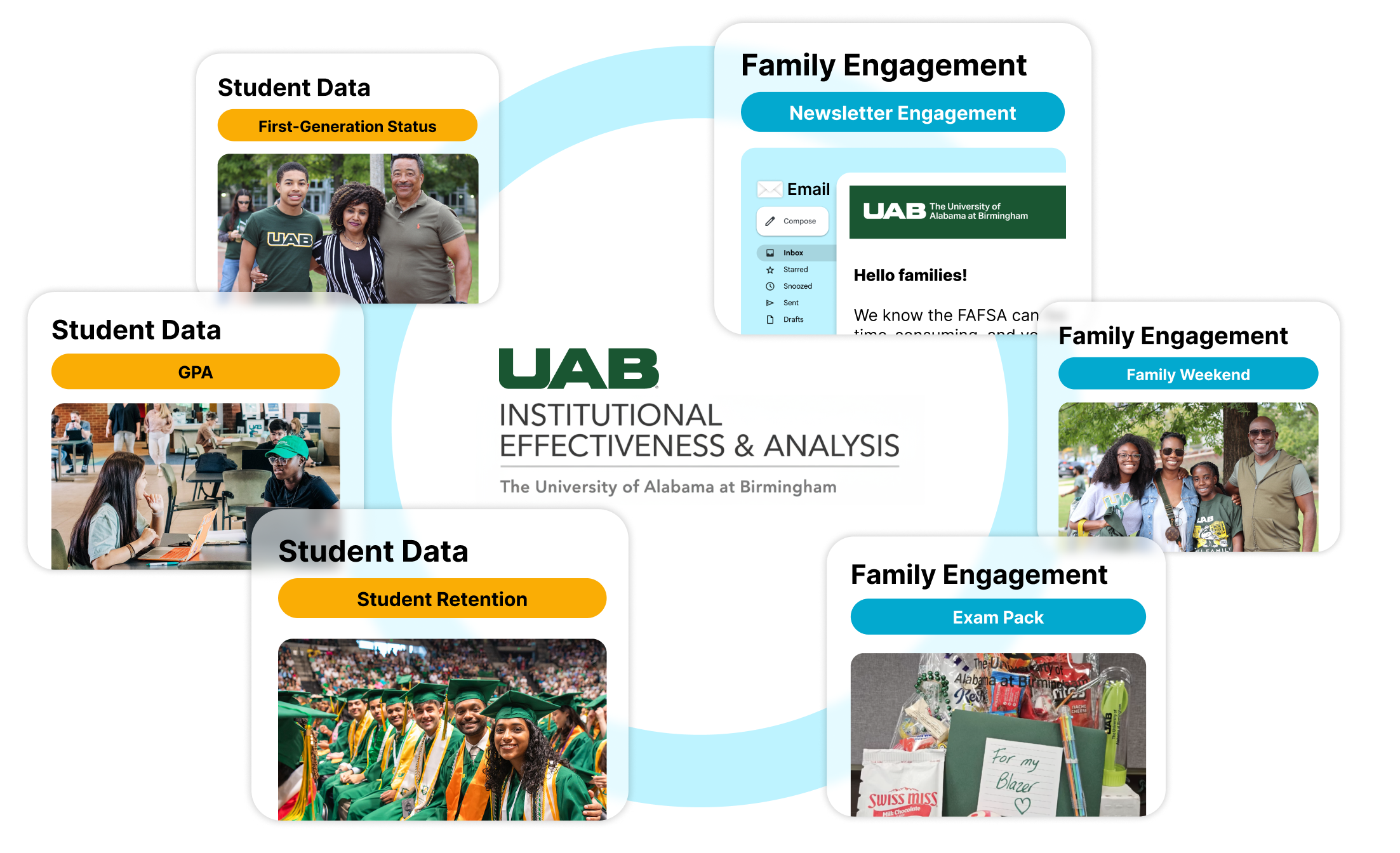
They merged institutional student data (Pell status, first-gen status, housing, race/ethnicity, college enrollment, GPA, and retention) with five family engagement indicators:
Family Weekend attendance
Exam Pack participation
Postcards
Valentine’s Day engagement
Newsletter engagement (via CampusESP)
The goal: determine whether family engagement correlates with first-term GPA and fall-to-fall retention.
Academic impact: A 0.14 GPA lift
Students whose family members engaged in at least one fall activity had:
3.29 average first-term GPA
vs.3.02 for students with no family engagement
In regression modeling (controlling for Pell, race, gender, first-gen status, housing, etc.), family engagement remained statistically significant — with engaged students earning GPAs 0.14 points higher on average.
Retention outcomes: A 16-point swing
UAB didn’t just measure family engagement as “yes/no.” They created family engagement tiers:
0 events
1–2 events (low)
3 events (moderate)
4–6 events (high)
Retention outcomes:
No engagement: 75.2% retained
Moderate engagement (3 events): 86.4% retained
High engagement (4–6 events): 91.3% retained
That’s a 16-point swing between no engagement and high engagement.
When they ran logistic regression controlling for GPA and other student characteristics, the signal held:
Moderate engagement → 1.58x higher likelihood of retention
High engagement → 2.65x higher likelihood of retention
This isn’t about sending one email and calling it a strategy.
This is about sustained, structured engagement.
What this does (and doesn’t) prove
UAB is clear: this is exploratory analysis. It does not prove causation.
Retention is influenced by many structural factors, including Pell eligibility, first-gen status, and first-term GPA.
What the data does show clearly: Across the range of first-term GPAs, students with moderate and high family engagement had higher predicted probabilities of retention.
Family engagement wasn’t noise in the model.
It was a variable that moved student retention.
Why family engagement matters now
Higher ed is entering a decade defined by:
Enrollment pressure
Increased Pell and first-gen populations
Performance funding tied to retention
Budget constraints
Retention strategies typically focus on tutoring, advising, analytics, early alerts.
All important. But this research reinforces what many Student Affairs leaders already suspect:
Families are part of the student success ecosystem.
And when engagement is intentional — not transactional — outcomes improve.
What this means for institutions
Volume and consistency matter. One touchpoint doesn’t move outcomes. A structured engagement strategy does.
Family engagement is a retention strategy. Not just a communications initiative.
Data infrastructure is essential. This study was possible because engagement data could be merged with institutional student data. If family engagement lives in spreadsheets, inboxes, or event RSVP lists, it cannot be measured — and it cannot be optimized.
The bigger question
If moderate and high family engagement are associated with materially higher retention odds… why is family communication still treated as optional infrastructure on so many campuses?
The schools that win over the next decade will not just invest in student analytics.
They’ll invest in the full student support network.
Families included.