
First-gen families: Support from day one

For many first-generation students, stepping onto a college campus isn’t just a milestone, it’s a moment that impacts their entire family. Families are proud, hopeful, and ready to support their students, yet often unsure how to navigate a system they’ve never experienced themselves.
And in that uncertainty, one thing becomes clear: the way an institution communicates with first-gen families in the earliest days is the foundation for the rest of their journey.
In our recent webinar, Montclair State University and Southern Oregon University shared how they’re embracing this reality, and it’s not with massive new programs, but with thoughtful, strategic shifts in communication that make first-gen support feel personal, accessible, and culturally aware.
Whether you’re rethinking your whole strategy or taking a small, meaningful next step, these institutions offer truly inspiring examples. Read below, or skip ahead to the discussion.
Give families what they need most: Clear, timely, actionable communication year-round
For many first-gen families, the barrier isn’t willingness, it’s uncertainty. They want to support their students; in fact, 57% of first-gen families communicate with their students daily, compared to 39% of continuing-generation families, but they often don’t know what to look for or where to find it.
Simple, consistent communication matters and SOU’s year-round approach shows why:
Southern Oregon University showed how powerful small, well-timed messages can be. A quick reminder about the last day to drop a class for a full refund helped families guide their students and avoid unnecessary debt. SOU leaned into this level of transparency, knowing 34% of first-gen families struggle to find academic calendar details on their own.
They also took the same approach to student well-being. During winter break, a short alert about virtual mental-health services reached families at a moment when academic pressure and homesickness often collide. They reinforced the message through text, a critical choice given that 56% of first-gen families prefer text messaging over email.
Families also responded strongly to reminders about scholarships, housing deadlines, and financial-aid timelines, critical support given that 65% of first-gen families struggle to find this information on their own.
These moments gave families what they needed most: clarity.
Provide resources that reduce anxiety
What families need most are simple structures that make the college experience feel understandable rather than overwhelming. Many of the tools they highlighted are small operational shifts but they dramatically reduce anxiety for families who don’t have a roadmap to follow.
Here are some of the strategies any campus can adopt quickly:
Build connection through representation
Montclair’s team intentionally highlighted first-gen faculty and staff, sharing personal stories of challenge, resilience, and advice. These spotlights were published directly in CampusESP so families could see themselves reflected in the community.
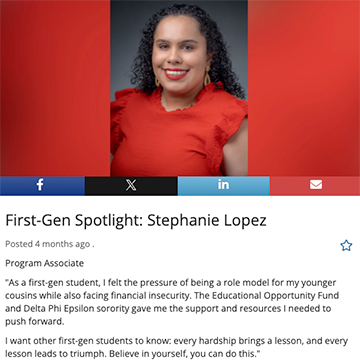
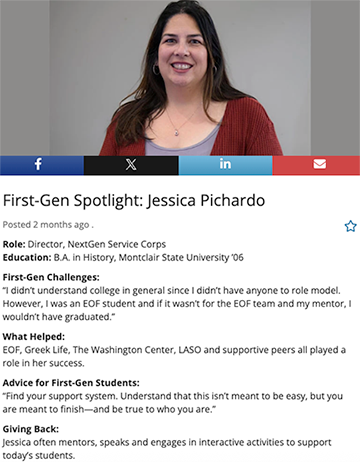
Families reacted strongly to seeing staff “who had walked the same path their students are walking now,” said Kelsey Nyman, Coordinator of Student Communications, Montclair State
Provide “college lingo” guides
For many first-gen families, the hardest part isn’t the content, it’s the vocabulary. Terms like “bursar,” “FERPA,” “credit hours,” or “drop/add” can be intimidating if you’ve never encountered them before.
Montclair translated their terminology guide into Spanish and made it accessible through their CampusESP portal and orientation materials. This ensured that families didn’t arrive at orientation already feeling behind.
And for campuses with limited staff capacity, CampusESP makes this even easier. With AI tools built directly into the platform, teams can generate a first draft of a terminology guide tailored to their institution and then refine it for accuracy, tone, and cultural relevance.
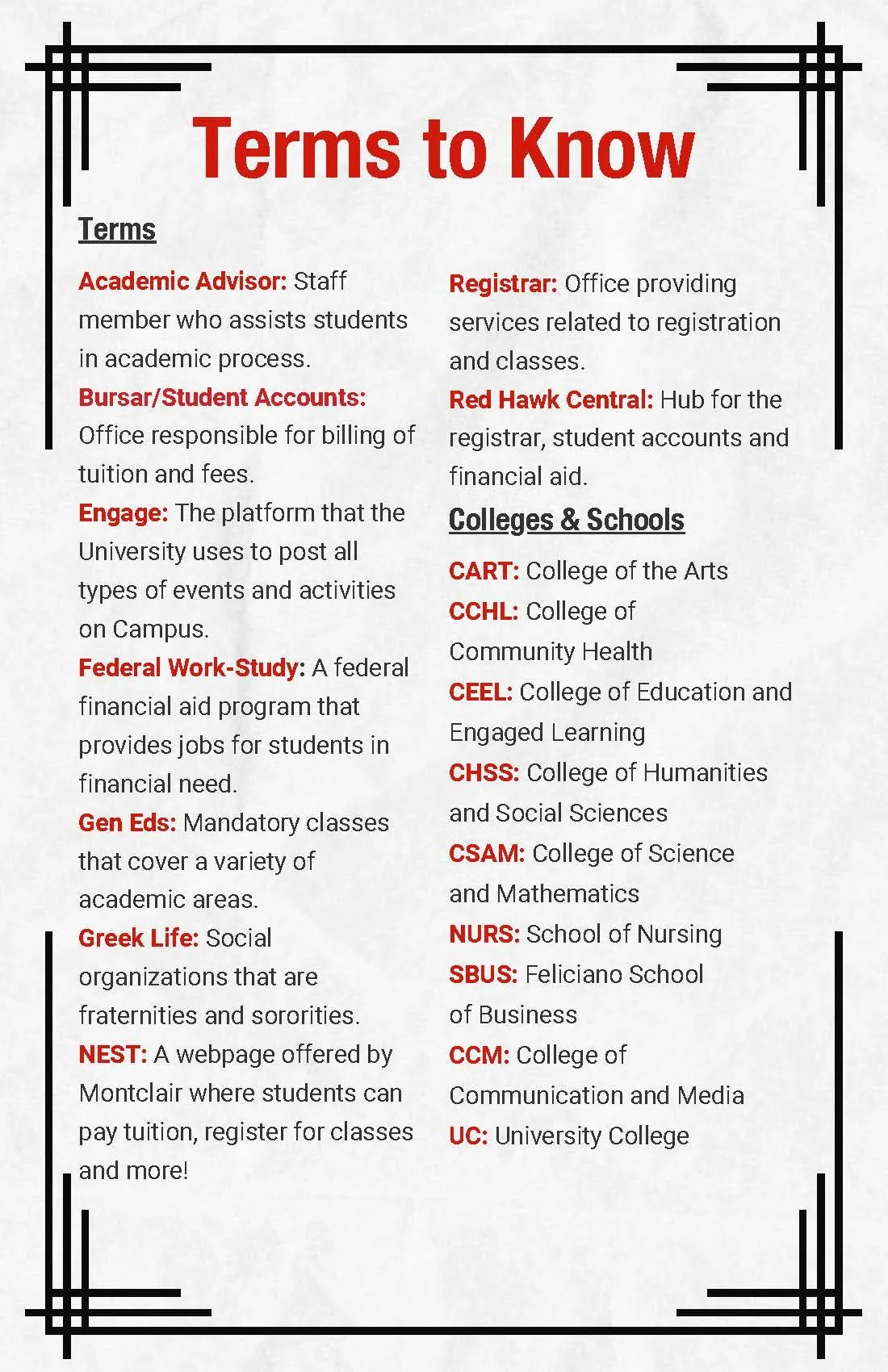
This allows you to create resources quickly and send them to first-gen families before they arrive on campus, helping them feel informed, included, and confident from the start.
Provide judgment-free spaces for questions
CampusESP Discussion Boards give families the freedom to ask questions without worrying whether they’re “supposed” to already know the answer. The moderation tools, including AI filtering and vetted human moderators, keep the conversation helpful and accurate.
Discussion boards eliminate the headache of parent Facebook groups, where misinformation can spread quickly and disproportionately affect first-gen families.
You don’t have to be first-gen to make a first-gen impact
As the webinar came to a close, Kyle shared a reminder that perfectly captured the heart of this work: you don’t have to be part of a community to serve it well. He spoke openly about not being first-gen or Spanish-speaking himself, yet playing a key role in bringing many of these initiatives to life.
His point was simple and powerful:
“You don’t need to be part of the community to help the community. What matters is listening, learning, and partnering with the people who can guide you.” Kyle Cashin, Program Coordinator, Montclair State
This spirit defined both Montclair’s and Southern Oregon University’s approaches. Their success wasn’t driven by having large teams or identity-perfect staffing, it’s built through collaboration, humility, and a shared commitment to meeting families where they are.
First-gen family engagement doesn’t require perfection. It requires intention.