

Inside DigiPen’s yield strategy: Why admits don’t enroll alone
DigiPen Institute of Technology (DigiPen) is unlike most colleges. Founded in 1988 in Redmond, Washington, it was the first institution in the world to offer a bachelor’s degree in video game programming. Today it enrolls just over 1,000 undergraduate students and has been ranked among the top video game design schools in the U.S. for 16 consecutive years by The Princeton Review.
“We’re ranked number one for highest salary when you graduate,” said Jeff Hill, Vice President of Admissions and Outreach at DigiPen Institute of Technology. “So we like to instill passion and help students realize their dreams.”
But communicating that value to families takes more than statistics. It takes trust. Students may be the ones deciding which school to commit to, but families are often helping weigh the biggest questions: whether the degree will lead to real career opportunities, whether the investment is worth it, and whether the school is truly the right fit.
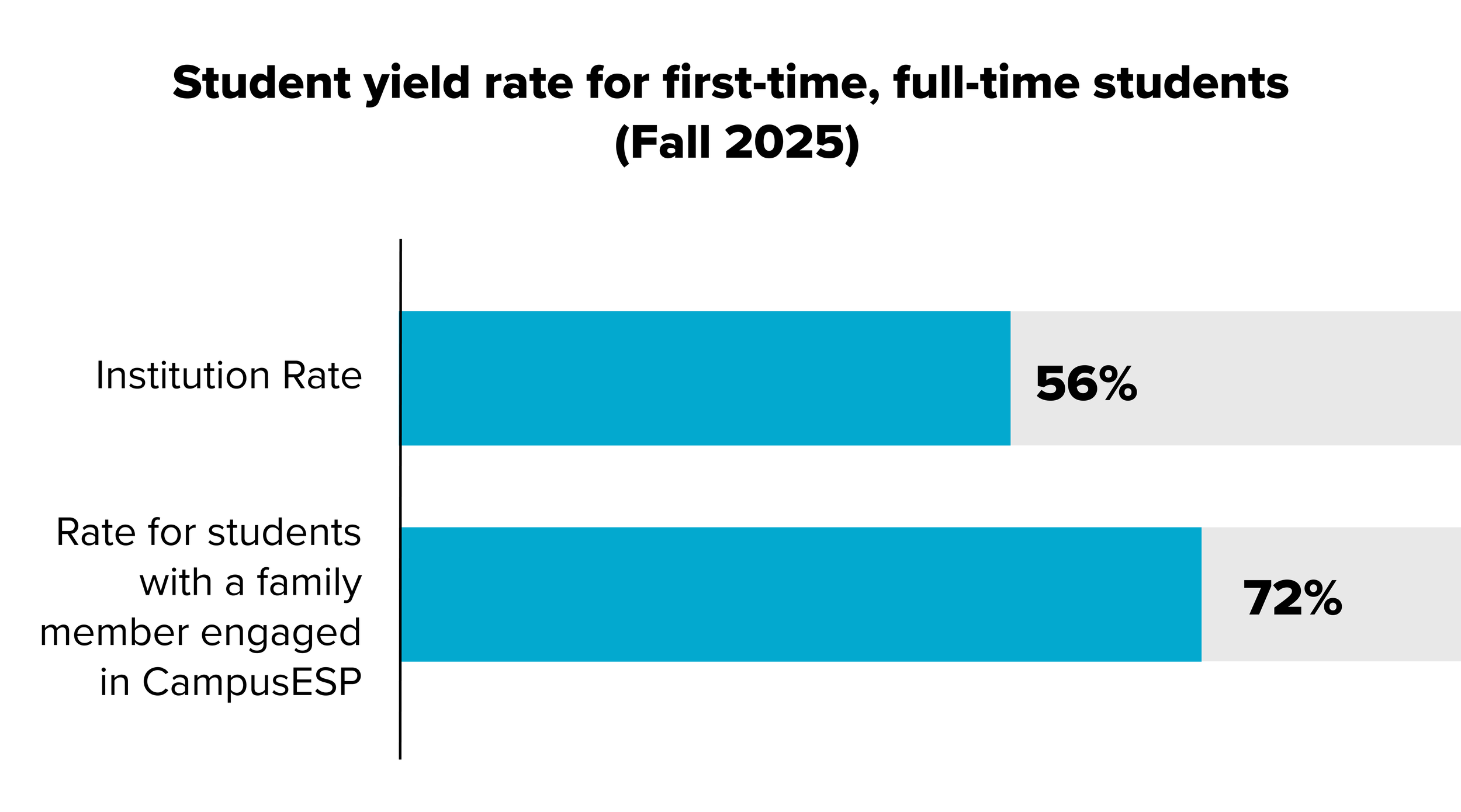
That reality came through clearly in my conversation with Jeff Hill, Vice President of Admissions and Outreach at DigiPen. His team has made family communication a central part of the admit-to-deposit window, turning it into one of the most effective levers in DigiPen’s enrollment strategy. And it shows: students with a family member using CampusESP have yield rates 16 percentage points higher than the institution average.
You can read more about their approach below, or watch the full conversation here.
Enrollment decisions rarely happen without families
The admit-to-deposit window is both emotional and financial. Families are evaluating cost, career outcomes, and fit while helping their student make one of the biggest decisions of their life.
And they expect institutions to communicate during that process. In fact, 77% of prospective families expect communication from their student’s college at least weekly.
For Hill, that expectation changed how DigiPen approaches outreach. “I used to hold back on how many messages we sent,” he said. “But I can’t tell you how many times I’ve heard a parent say, ‘Thank you for communicating with me.’ They want the information.”
Instead of limiting communication, DigiPen leaned into it. The goal isn’t to send more messages. It’s to give families the clarity they need when decisions are actually happening.
And when families engage with that information, enrollment outcomes follow. At DigiPen, 72% of admitted students with a parent using CampusESP enrolled, compared to the 56% institution rate.
Build trust before the deposit ask
At DigiPen, the conversation with families starts long before the deposit deadline.
Hill’s team begins sharing practical guidance even when students are still in high school — things like senior-year checklists, FAFSA reminders, and timelines explaining what the college search actually looks like.
“Families are trying to figure out this process just like students are,” Hill said. “If we can help them earlier, it changes the entire relationship.”
Instead of appearing only when it’s time to submit forms or make decisions, DigiPen becomes a resource families can rely on throughout the process.
The goal is to show families that DigiPen understands the weight of the decision and is there to help them navigate it. By the time students are admitted, the institution already feels familiar and helpful.
Humanize the people behind the institution
Not every message DigiPen sends is a reminder or checklist. Sometimes the goal is simply connection.
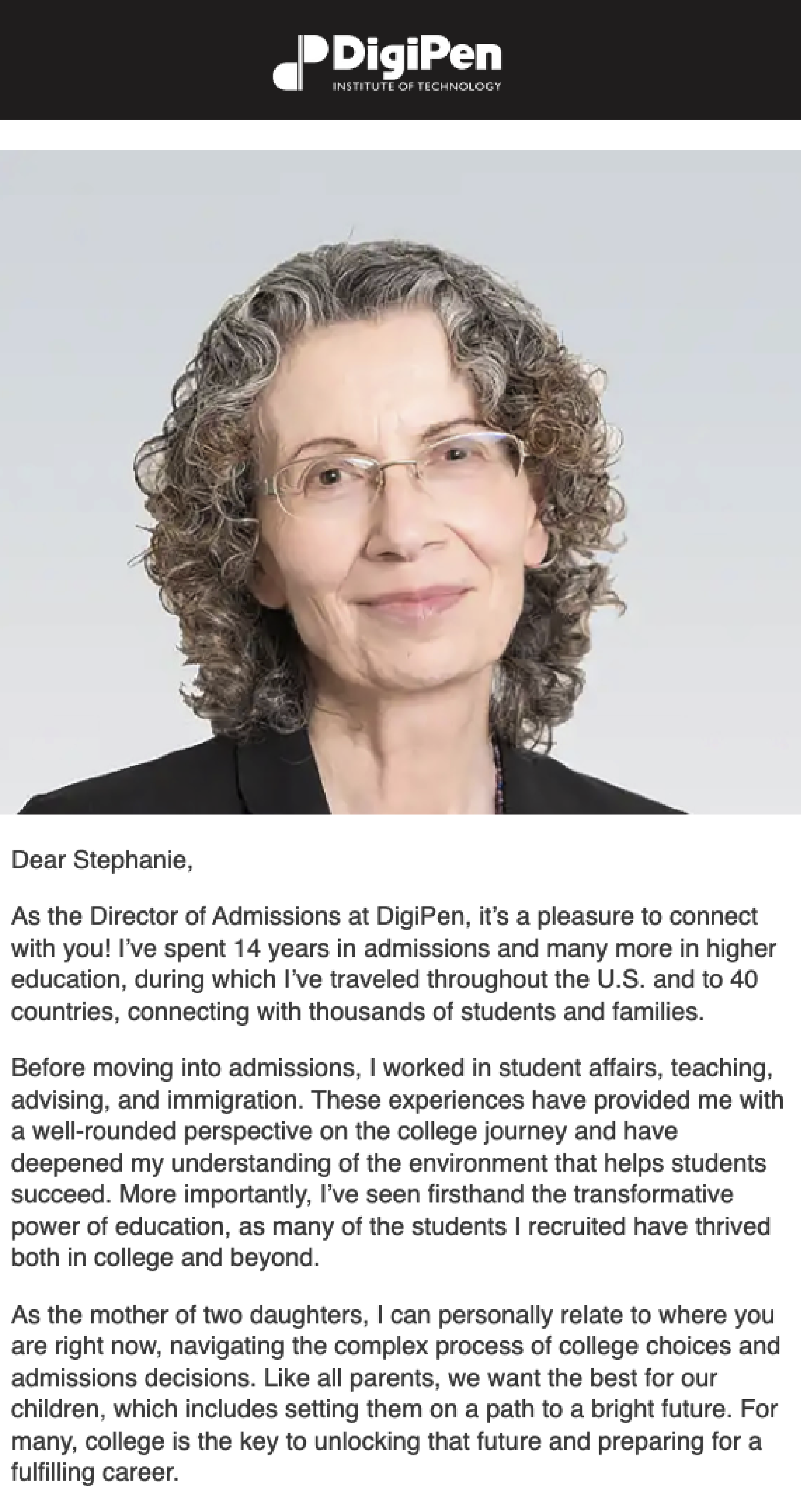
One email introduces families to Marie Whalen, the Director of Admissions, and explains why she does this work. Hill encouraged her to include something personal in the message.
She mentioned that she’s the mother of two daughters and understands what families are feeling during the college search. That small detail changed the tone of the email.
“I don’t just want to send emails that say, ‘We need this from you. Go do this,’” Hill said. “Parents are human beings. They don’t want to just hear what we want from them.”
After sending the message, Hill received a long email from a parent thanking the admissions team and saying the message made them feel more comfortable about the process.
Sometimes the most effective message isn’t a call to action. It’s simply a reminder that there are real people behind the institution.
Reach families when decisions intensify
What institutions say matters. But when they say it can matter just as much. One moment DigiPen pays close attention to is winter break.
Families are together. Conversations about college are happening around kitchen tables and living rooms. If institutions go quiet during that time, competitors fill the space.
So DigiPen sends a well-timed message reminding families about the deposit deadline, reinforcing excitement about joining the DigiPen community, and outlining the next steps.
The message goes to both students and their families. But families engage with it very differently.
The same email sent to families saw a 69% open rate and 5.6% click rate, compared to 46.6% opens and 3.4% clicks from students.
When the message arrives at the moment families are already talking about college, it does more than remind them about a deadline. It becomes part of the conversation.
Help families see the return on investment
Cost and financial aid remain the most influential factors shaping enrollment decisions. At the same time, confidence in higher education’s value is slipping. In fact, satisfaction with tuition as a worthwhile investment dropped from 77% to 59% in just one year.
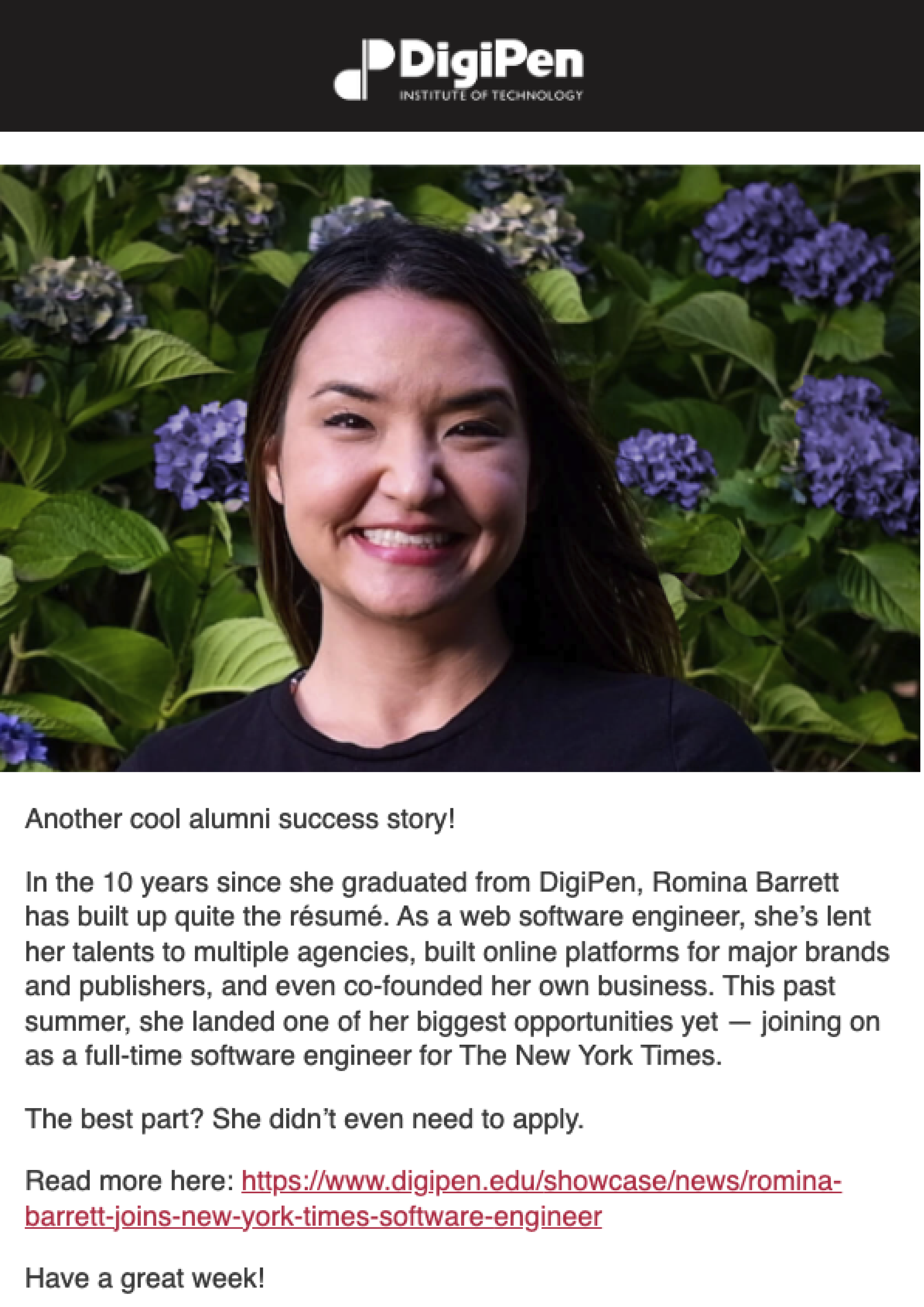
To address that concern, DigiPen regularly shares alumni success stories alongside career outcomes data. These stories highlight where graduates are working and how their DigiPen education translated into real careers.
“Some parents think their student is going to college to play video games,” Hill said. “So we show them the careers. We talk about companies like Microsoft and the kinds of jobs our graduates have.”
Those examples help families see how a passion for gaming can translate into real-world careers — and a meaningful return on investment.
Turn interest into commitment
Even with strong communication, some decisions require an in-person experience.
At DigiPen, one of the most powerful moments in the yield cycle is Admitted Dragon Day, the institution’s largest admitted student event. Families meet faculty. Students connect with future classmates. Sessions highlight programs, career outcomes, and what life at DigiPen actually looks like.
Those experiences create something email alone cannot: momentum.
“I literally see event registrations come in after we send messages to parents,” he said.
Once families arrive, the experience does the rest. “When students walk through the doors, you can see the look on their face that they’ve found their people.”
That moment — when a student can picture themselves belonging — often turns interest into commitment.
When families engage, students enroll
DigiPen’s approach isn’t about sending more emails or building complicated campaigns. It’s about understanding how enrollment decisions actually happen.
A few lessons stand out:
Start communicating with families earlier than you think you should
Balance practical information with human stories
Show clear outcomes so families understand the value of the degree
Pay attention to the moments when decisions intensify
Because students may submit the deposit. But the decision to enroll almost always happens together.