
Win yield through family confidence: communicate financial aid and ROI effectively

Every campus has seen it: a frustrated parent trying to interpret an award notice, a cost estimate, or a checklist item their student never mentioned. The questions come fast: What does this mean? What will it actually cost?
When families are confused about financial aid and cost, enrollment decisions don’t just slow down, they stall. And sometimes, they disappear entirely.
That’s because communication with parents has become one of the most critical parts of the decision process. In fact, 94% of families say the quality of a school’s communication with parents matters. Cost and financial aid now drive nearly every family conversation. And while institutions often treat “financial aid” and “paying the bill” as separate topics, families don’t. They just want clear answers to two questions: Can we afford this? And is it worth it?
That’s why we sat down with Todd Abbott from Liaison and Barb Roberts from the University of Nevada, Las Vegas (UNLV) to talk about how building family confidence around financial aid and ROI directly impacts yield.
Read below, or skip ahead to the discussion.
Why UNLV made families a priority
Located in the heart of Las Vegas, UNLV serves more than 33,000 students and is one of the most diverse institutions in the country. Half of its students are first-generation, meaning many families are navigating college finances for the first time.
“For so many of our students, the family is a huge stakeholder,” Barb Roberts explained. “With so many of them being first gen, we knew that we had to explain things to parents and not let it be a pass-through.”
Once UNLV made families a priority, the focus shifted from sending more messages to sending clearer, more relevant ones.
The results were immediate: financial aid ticket resolutions dropped 87%, call volume to financial aid and cashiering offices fell 50%, and FAFSA completion increased, without a rise in loan borrowing. Families gained clarity, and enrollment decisions moved forward with confidence.
Start financial aid conversations earlier
UNLV doesn’t wait for FAFSA to open to start talking about cost. Instead, the team sets expectations early by helping families understand how college costs, aid, and borrowing work together before deadlines add pressure.
That early context is especially important at an access-focused institution serving many first-generation students. As Barb shared, paying for college the way previous generations did — working full time while attending school full time — is no longer realistic, as aid and loan limits haven’t kept pace with rising costs. Families are being asked to invest more, and they need clear guidance to understand what that means.
UNLV also recognizes that FAFSA isn’t accessible for every family. To avoid leaving students behind, the university created an institutional aid application as a backup, using it to help allocate institutional dollars when FAFSA wasn’t an option.
All of this requires sustained communication with families, but it’s paying off. Families understand their options earlier, follow through more quickly, and move forward without an increase in loan borrowing.
Clarity builds confidence: Define the language and connect it to the bill
For many families, confusion doesn’t come from a lack of information, it often comes from unfamiliar language.
As Barb shared, being clear often means starting with definitions. “It’s really creating a glossary of things,” she said. As a first-generation college student herself, Barb knows how easy it is to get lost in higher ed terminology. Even now, she noted, there are messages she wouldn’t fully understand if she didn’t work in higher education.
That disconnect matters, especially when only 25% of families say financial aid information is easy to navigate.
Confusion increases when financial aid, cost of attendance, and paying the bill are treated as separate ideas. Families receive an award notice and assume it explains what they owe, without realizing that financial aid and the actual bill are not the same thing.
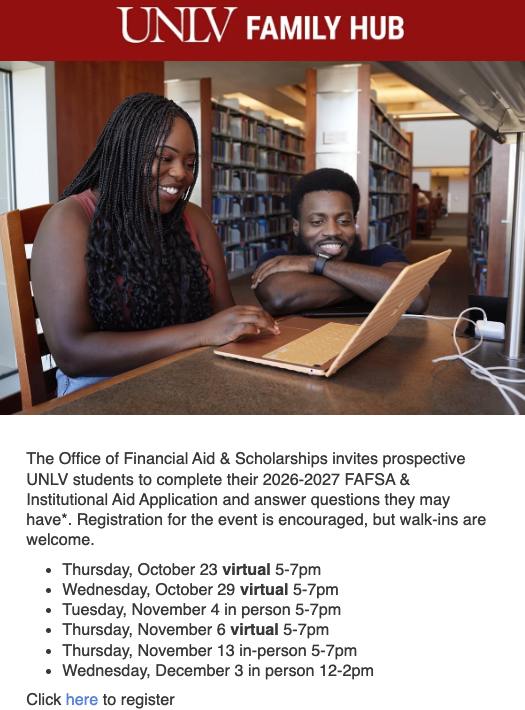
Cost of attendance adds another layer. Institutions often present it as a single number that includes expenses families won’t pay directly to the university. Without clear context, families are left wondering why the number they see doesn’t match the bill they’re expected to pay.
By slowing down, defining terms, and clearly breaking out direct versus indirect costs, while showing how financial aid applies to the bill, institutions can remove a major source of confusion. When families understand both what the numbers mean and how they relate to what they owe, they’re far more confident moving forward.
Segment intentionally to avoid noise fatigue
UNLV didn’t improve engagement by blasting reminders to everyone. They improved it by making sure families only received messages that applied to them.
“If you can’t define who you’re talking to and what you’re saying,” Barb noted, “people will eventually just start ignoring your messages.”
That meant “slicing and dicing” data and targeting FAFSA reminders only to families who still needed them and avoiding message fatigue.
Tools within CampusESP help make this possible at scale. By using CRM data and family communities to segment audiences, institutions can tailor communication based on where each family is in the process. The Admissions Dashboard then surfaces real-time admissions and financial aid status for families, while Parent Promoter Score helps identify which families are engaged and which may need additional guidance before uncertainty stalls decisions.
Show families the ROI clearly and early
Families struggle to find information about career outcomes not because it doesn’t exist but because higher ed often doesn’t talk about it the way families think about it. In fact, while 94% of families say information about graduates getting jobs is essential to their decision, 68% say they can’t easily find it.
As Barb explained, families are looking for jobs and ROI, while institutions tend to lead with terminology like outcomes data. “Families talk about jobs. They talk about ROI,” she said. “What do we talk about? ‘Outcomes data.’”
The disconnect is subtle but powerful. Very few families go to a website searching for a first-destination survey or a multi-year outcomes report. They want to know what their student will do after graduation, how quickly they’ll find work, and whether the degree will pay off over time.
The disconnect is subtle but powerful. Very few families go to a website searching for a first-destination survey or a multi-year outcomes report. They want to know what their student will do after graduation, how quickly they’ll find work, and whether the degree will pay off over time.
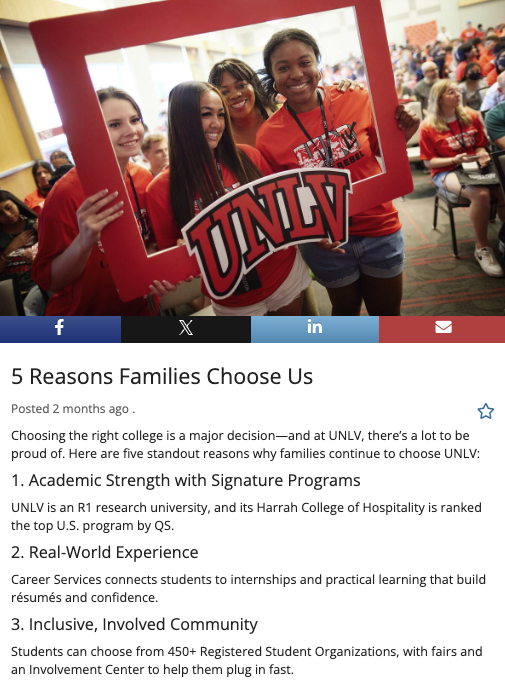
At UNLV, this realization led to a reframing of how value is communicated, shifting away from institutional labels and toward stories and signals families recognize: career paths, internships, job placement, and long-term earning potential. Not just what happens one year after graduation, but how a degree supports a lifetime of opportunity.
The bottom line
College costs have risen. Aid hasn’t kept pace. For many families, closing the gap requires real sacrifice.
When institutions don’t clearly explain what that means,or how families can navigate it, confidence suffers. And without confidence, even interested students hesitate.
UNLV’s experience shows that when families understand what’s expected, what it will cost, and what the value looks like on the other side, enrollment decisions move forward.
As Barb shared, their work is deeply tied to the institution’s access mission and commitment to first-generation students. The goal wasn’t just enrollment, it was helping students succeed without increasing loan borrowing, even as tuition rose.
All of it required sustained communication with families. And that investment paid off.
“It’s been a game changer for us,” Barb said.