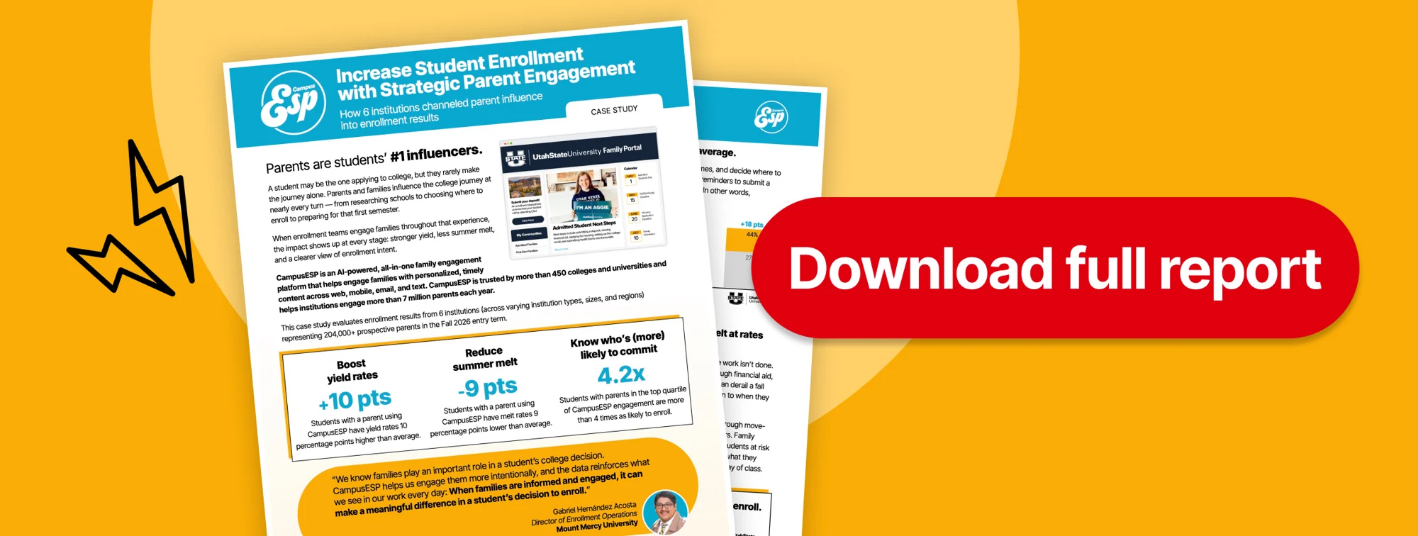
How 6 institutions increased Fall 2026 student enrollment with CampusESP

Parents and families influence the college journey at nearly every turn — from researching schools and completing applications to weighing financial aid, choosing where to enroll, and helping students follow through on the many details between admission and move-in.
For enrollment teams, family engagement offers a valuable signal of intent, helping teams understand how engaged a student is and how likely they are to enroll.
To better understand this connection, we analyzed Fall 2026 enrollment data from six institutions using CampusESP for Student Enrollment across different institution types, sizes, and regions, representing more than 204,000 prospective parents. Three key findings stood out:
Students with engaged parents enroll at higher rates. Students with a parent using CampusESP have yield rates 10 percentage points higher than average.
Students with engaged parents melt at lower rates. Students with a parent using CampusESP have melt rates 9 percentage points lower than average.
Higher parent engagement can identify students with stronger enrollment intent. Students with parents in the top quartile of CampusESP engagement are 4.2 times more likely to enroll
Students with engaged parents enroll at higher rates





Parents and families are highly involved in helping their student sort through options, compare costs, and decide where to commit. For enrollment teams, reaching families creates another way to support students as they move through this journey.
With CRM integration and automated messaging campaigns, CampusESP sends parents reminders to submit a deposit, apply for financial aid, and more — all based on a student’s stage in the enrollment funnel. Institutions “nudge the nudgers,” and students stay on track. Our analysis showed a strong relationship between family engagement and student enrollment behavior: students with a parent using CampusESP have yield rates 10 percentage points higher than average.
Students with engaged parents melt at lower rates
A deposit is a big milestone, but a lot still stands between a student saying “yes” and arriving on campus. Over the summer, students and families navigate financial aid, housing, orientation, and countless other practical and emotional details that can put a fall start at risk.
CampusESP keeps families informed and involved from deposit through move-in, sharing relevant information, flagging missed steps, and sending timely reminders — all without adding another communication channel for staff to manage.
Family engagement data helps enrollment teams identify students who may be at risk of summer melt and reach out before it’s too late — helping more students make it to the first day of class. Across the six institutions in the analysis, students with a parent using CampusESP had melt rates 9 percentage points lower than average.
Identify students with stronger enrollment intent with CampusESP’s Parent Promoter Score™
Family engagement isn’t one-size-fits-all. CampusESP’s Parent Promoter Score helps enrollment teams see (and operationalize!) that difference. Parent Promoter Score uses parent engagement data to assign each family member a score from 0-100, helping institutions understand which parents are highly engaged with their communications and content.
In the case study, the difference was significant: students with parents in the top quartile of CampusESP engagement were more than 4x likely to enroll. For enrollment teams, that’s another piece of information they can use alongside the student data they already have to plan and shape their class.