
From parent interest into enrollment impact: Lessons from KU & Assumption

Families aren’t waiting until senior year to enter the conversation. They’re researching early, asking the hard questions, and helping their students navigate one of the biggest investments they’ll ever make.
We sat down with the University of Kansas (KU), a large public flagship, and Assumption University, a small private Catholic, to explore how they’re approaching family engagement by building trust earlier, guiding families through the decision-making journey, and strengthening yield along the way.
If you’re looking for where to start or how to upgrade your current enrollment strategy, this guide brings together research-backed insight and real-world examples from two institutions already seeing results, from a 12.4% yield increase at KU to nearly 70% family portal engagement at Assumption.
The shared “aha”: families don’t want to be CC’d — they want to be engaged
96% of prospective families say the quality of a college’s communication with them is a critical part of their decision-making process. In other words, how you communicate with families matters just as much as what you communicate.
But as the University of Kansas discovered, knowing families matter and actually engaging them strategically are two very different things.
“We knew families were such an important part of the college decision-making process, everything in the data told us that. But when we looked honestly at our strategy, we realized we had a real gap. In the past, we were that school. We were either CC’ing parents on student emails or duplicating the student message with no difference in content.” Danielle Driesen, Associate Director of Marketing for Undergraduate Enrollment at the University of Kansas
That realization led KU to rebuild its approach by focusing on three strategic priorities:
Connecting with families earlier
KU began engaging families before senior year, reaching out as early as freshman, sophomore, and junior years — acknowledging that parents start forming opinions long before an application is submitted.Building trust through transparency
Instead of guessing, the team relied on data to shape content by focusing on the topics families care about most and struggle to find, and making those answers easier to access.Creating community to show value
KU recognized that engagement couldn’t stop at information-sharing. By launching the CampusESP portal (starting with admitted families and expanding to inquiries), they created an ongoing space for connection and continued support.
Assumption University recognized the same gap. As William Boffi, VP of Enrollment Management at Assumption University, shared:
“Parents are really important but for a long time, we didn’t have a strategy or communication that matched how important they actually are.”
For both institutions, that realization sparked the same shift: family engagement can’t be an afterthought. Parents need to be engaged intentionally, early, and as true partners in the decision making process.
The “dinner-table topics” families care about most
A family engagement strategy isn’t about creating more content, it’s about focusing on the topics that actually drive decisions.
While 78% of families still see higher education as a worthwhile investment, belief alone isn’t enough. Confidence is built — or lost — around a small set of questions families return to again and again:
Cost and tuition (the #1 decision factor)
Financial aid clarity
Academic majors and fit
Career outcomes and ROI
At KU, this meant moving beyond surface-level messaging and proactively addressing these topics. Families weren’t just told what to do, they were shown how to interpret information:
What tuition and aid actually look like at KU (beyond sticker price)
How to read and compare financial aid packages
What outcomes look like after graduation, supported by real examples
Housing, orientation, and next steps tied directly to where the student was in the funnel
Rather than assuming families would “figure it out,” KU brought the answers directly to them.
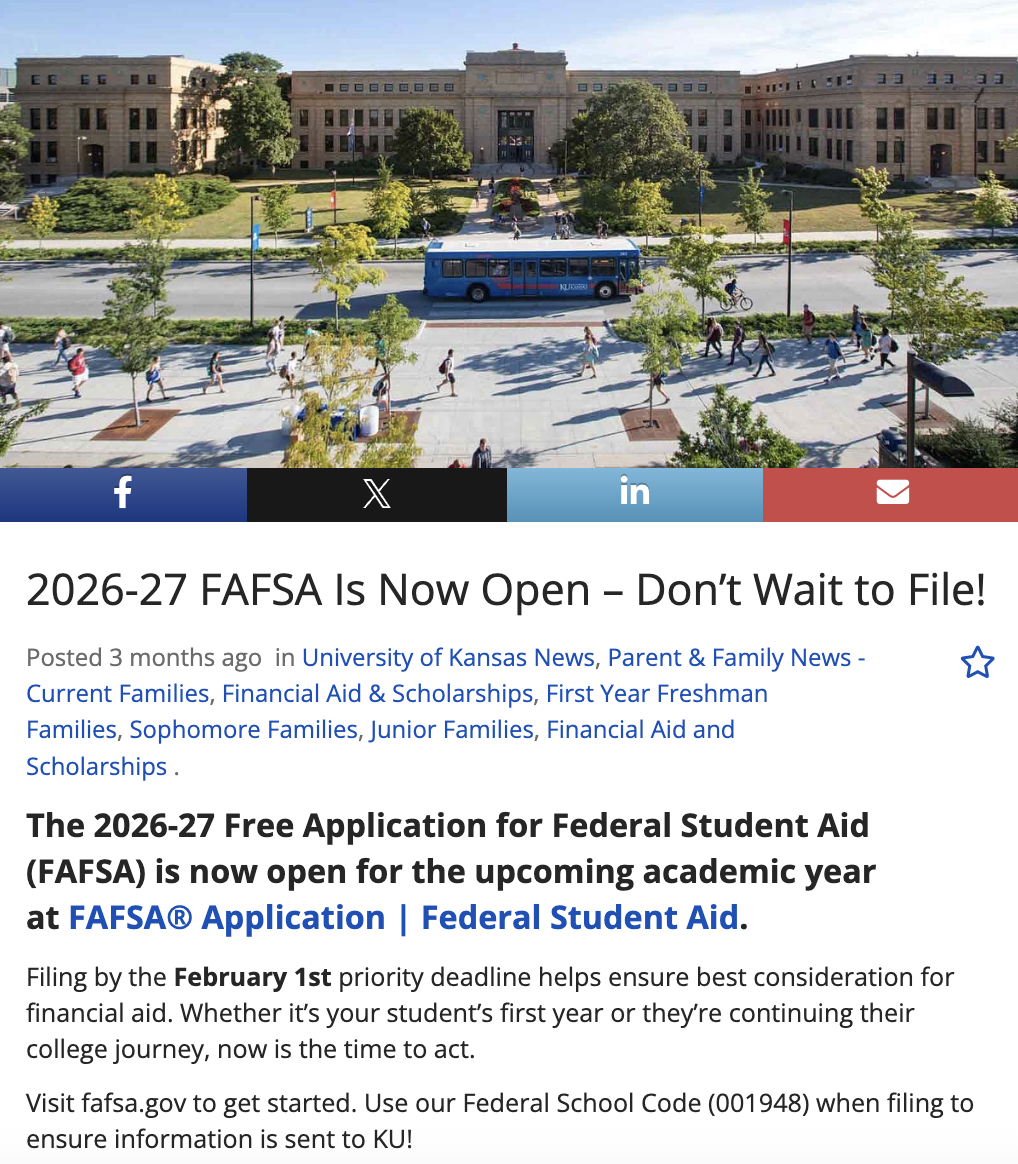
“Are we communicating too often?” Not for families
One of the most common hesitations enrollment teams share is frequency: Are we sending too much?
CampusESP research offers a clear answer: 72% of prospective families expect to hear from institutions at least weekly, and that expectation has remained steady over time.
As those expectations grow, families are also signaling how they want to engage. Many aren’t looking for more emails alone, they want a central place to find what they need, when they need it.
That’s why family portals have quickly become the second most requested communication channel, with demand up 12% over the past two years.
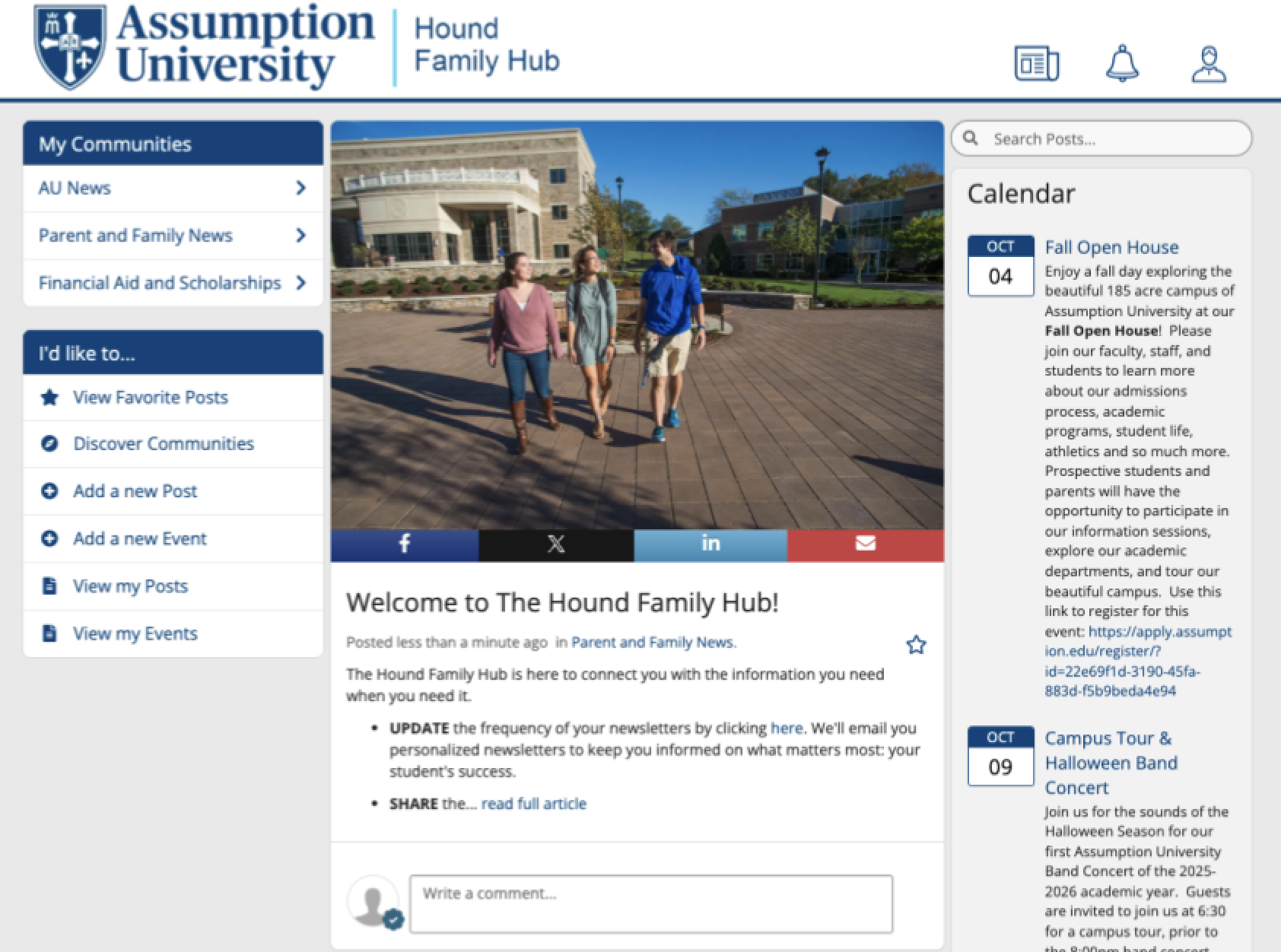
Assumption leaned into this shift by positioning their parent portal as a consistent, reliable home base, especially during moments of transition when families tend to feel uncertain. The response validated the approach: nearly 70% of admitted students’ families actively engaged in the family portal, reinforcing that parents aren’t tuning out, they’re leaning in when communication provides clarity and direction
Family engagement that drives enrollment results
While KU and Assumption tailored their family engagement strategies to fit the needs of their institutions, both focused on the same outcome: driving enrollment results by helping families feel informed, supported, and confident throughout the decision-making journey.
At KU, that meant pairing clear, family-specific communication with opportunities for connection. Discussion boards inside the CampusESP portal gave families a space to ask questions, learn from one another, and share milestones, turning information into community.
As Natalie Frick, Digital Marketing Strategist at KU, shared:
“We wanted families to feel like they could ask questions, connect with each other, and not feel like they were always being watched.”
That sense of connection had a measurable impact. Students at KU with a parent using CampusESP are yielding at 37%, compared to an institutional average of just under 24.6% (a 12.4% higher yield rate than average). Funnel data also showed a clear pattern: the more engaged the family, the more likely the student was to move from application to enrollment.
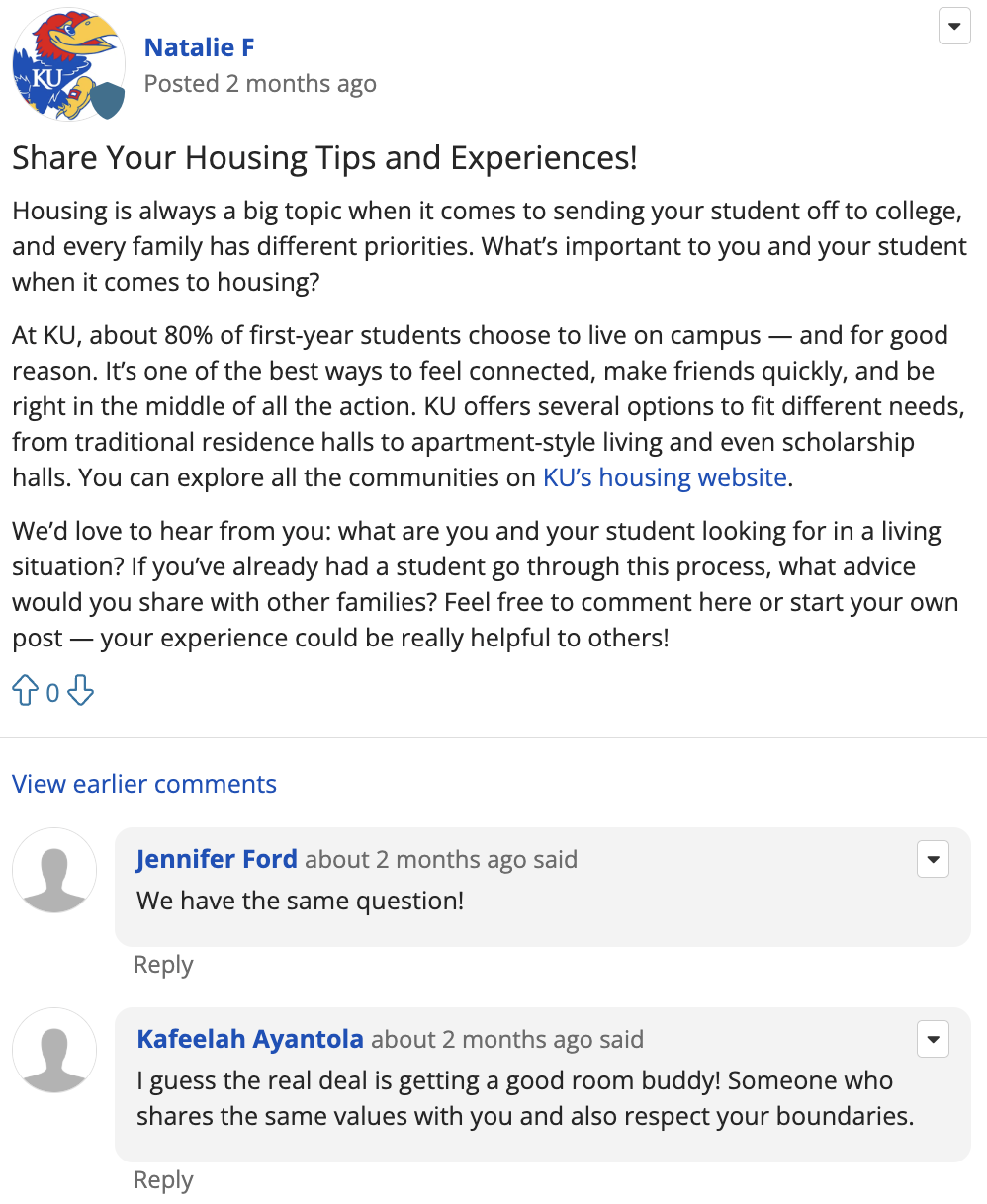
At Assumption, the focus was continuity. They focused on capturing parent contact information early through RFIs, event registrations, and other early touchpoints.

They used this data to build family-specific campaigns, written for parents — not copied from student messaging — focused on affordability, value, outcomes, and what comes next. This ensured communication matched the complexity of the decision families were helping students navigate.
For Fall 2025, Assumption’s overall institutional yield was 11.4%. But among families engaged through CampusESP, yield nearly doubled to 20%—and for their most engaged families, yield soared to 44%, nearly four times higher than the institutional average.
The takeaway was clear: when families are informed, supported, and intentionally engaged, they don’t just feel more confident, they help students enroll.
What enrollment teams can take away
“We’re talking to families like we’re sitting at the table with them, not talking at them.” - Danielle Driesen, Associate Director of Marketing for Undergraduate Enrollment, KU
That mindset is the real takeaway. When institutions align strategy with how families actually experience the enrollment journey, the impact compounds. Families gain clarity. Students gain confidence. And enrollment teams see stronger movement through the funnel.
Across both conversations, a clear playbook emerged:
Engage parents earlier than senior year
Lead with clarity around cost, aid, and outcomes
Communicate consistently, not sporadically
Create a home base families can return to
Treat communication like a conversation, not a broadcast
Collect parent data with intention and use it thoughtfully
If you’re looking to influence yield, build trust earlier, and give families the transparency they’re asking for, the experiences from University of Kansas and Assumption show exactly where to start.