


Two-year colleges offer students and families a strong value story that extends beyond affordability. They give students more flexibility to explore transfer pathways, career programs, and credentials without immediately taking on the cost of a four-year institution.
At St. Charles Community College (SCC), affordability gives families a compelling place to start. For eligible students, Missouri’s A+ Scholarship Program provides scholarship funds toward tuition at participating public community colleges, making SCC more accessible to local families.
But earning their consideration is only the beginning, families need to see the support, opportunities, and pathways SCC offers.
That’s why Laura Powell, SCC’s Director of Recruitment, and her team use CampusESP for Two-Year Colleges to give families personalized content, timely text reminders, and practical information they can use to support their students as they complete each enrollment step.
After registration, that communication continues, keeping career resources, academic support, events, and other opportunities visible to families. SCC found that more than 60% of its FERPA access requests were initiated by students themselves, showing that students actively want trusted supporters involved in their college experience.
By keeping those supporters informed, SCC gives them practical ways to point students toward help, opportunities, and campus resources when they need them.
Want to hear how SCC puts this strategy into practice? Listen to the full conversation.
A scalable approach to enrollment communication
SCC’s BeReady program helps high school seniors across 32 schools complete five enrollment touchpoints, from application and placement testing through orientation and first-semester registration. Read the full story for a closer look at the program.
Before CampusESP, much of the communication depended on high school counselors passing information to students about applications, placement testing, and what they needed to bring. Important details would get lost along the way.
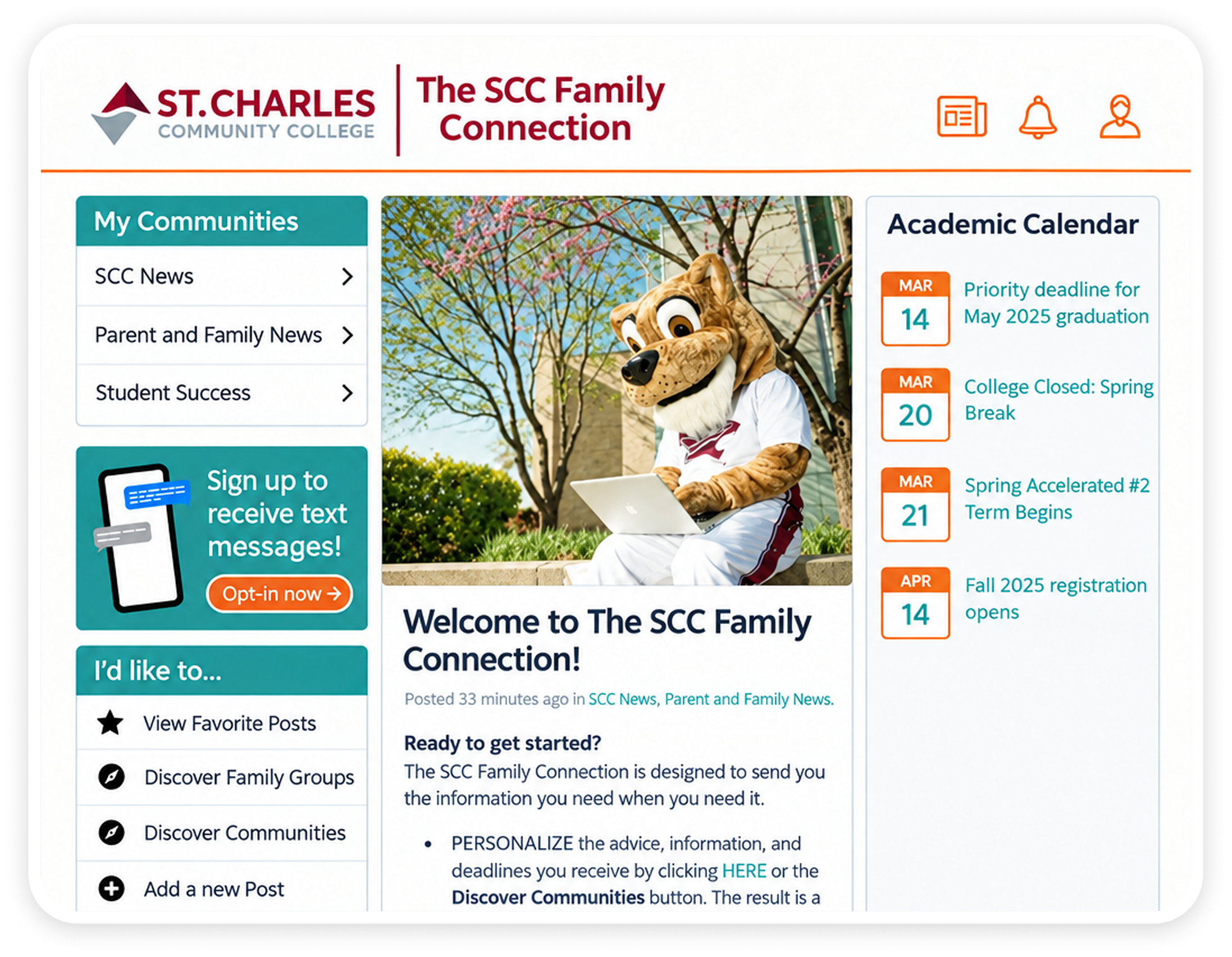
With CampusESP families receive personalized reminders before each step, including one-week and one-day notices. Recruiters build each high school’s communication calendar before the busy season begins. They personalize and schedule reminders in advance, then link families to standing CampusESP posts that hold the full details. When something changes, the team updates the information in one place.
“We’re really only doing it one time and then cloning every school,” Powell explained. “They go in, they set them, they’re done, hands off. It can’t be any easier for them, and it has been truly seamless for us.”
That structure became especially valuable when Powell’s recruitment team temporarily dropped from four recruiters to two. She estimates that each recruiter spends less than five hours setting up a full year of reminders for all of their schools. Before CampusESP, the team returned to the same manual communication work every month.
“I don’t know how four people could do all the things they’re doing in all these schools without what CampusESP helps provide,” Laura said. “I don’t know that we could do that as efficiently and not overload our counselors.”
Turn emails into text messages that drive action
Email remains the top communication choice for two-year college families, but text is not far behind. In fact, 45% of families prefer text messaging, while only 35% of two-year colleges currently use it to reach families.
At SCC, more than 877 parents have opted in to receive text messages.
“Parents love the text messages,” Powell said. “They get the text, they hit it, and it takes them right to the standing post with all the details.”
SCC uses text to send timely reminders families can use to support their student’s next step, without giving staff another message to write from scratch.
With CampusESP’s AI-powered workflows, SCC can turn an existing email or post into a concise text. The tool identifies the key action, simplifies the language, and links families to the full details. Staff can review the message, make adjustments, or translate it before sending.
Bring campus departments together around family communication
CampusESP helps prospective families see where an SCC education can lead, while giving current families a clearer view of the resources, relationships, and opportunities that support students after they enroll.
Career resources connect programs to job opportunities, while alumni stories give families a real example of where an SCC credential can lead. Transfer information helps families understand how a student can continue toward a bachelor’s degree. Posts about tutoring, wellness services, and campus activities show current families where students can find help and build community.
Each message answers part of the value question. Prospective families can picture the outcome. Current families can point their student toward a career event, academic help, or another resource when it is useful.
Powell brings campus departments into that communication. “I literally work with every department on campus,” she explained. Career services, tutoring, student activities, health and wellness, and other teams contribute information from their own areas of expertise.
“I think it’s better to have the people who are the most passionate about what they’re doing, as well as the most knowledgeable about the content, create the content,” Powell said.
That does not mean departments need to start from scratch. “Think of every flyer you’re already putting out to communicate something to students,” Powell told webinar attendees. “That’s your content. It’s done. You can shorten it or adapt it.”
Give families secure FERPA access while students stay in control
When communication involves student-specific information such as bills, holds, financial aid, grades, and class schedules, SCC uses CampusESP for FERPA Management to manage waivers and approved data sharing. Students always decide whether a family member or another trusted supporter can access that information.
“I was shocked when I realized that over 60% of our FERPA requests were initiated by the students,” Powell said. “The students are asking the parents to have this information. They’re saying, ‘Please help me with this.’”
The student remains in control, and the supporter does not have to be a parent. “It’s really supporters in our world of any flavor,” Powell explained. “It’s whoever they want who can help them.” That may be a grandparent, sibling, relative, or trusted friend who can offer guidance and connect the student with the right SCC resource.