

The enrollment signal your team is missing: Parent Promoter Score™
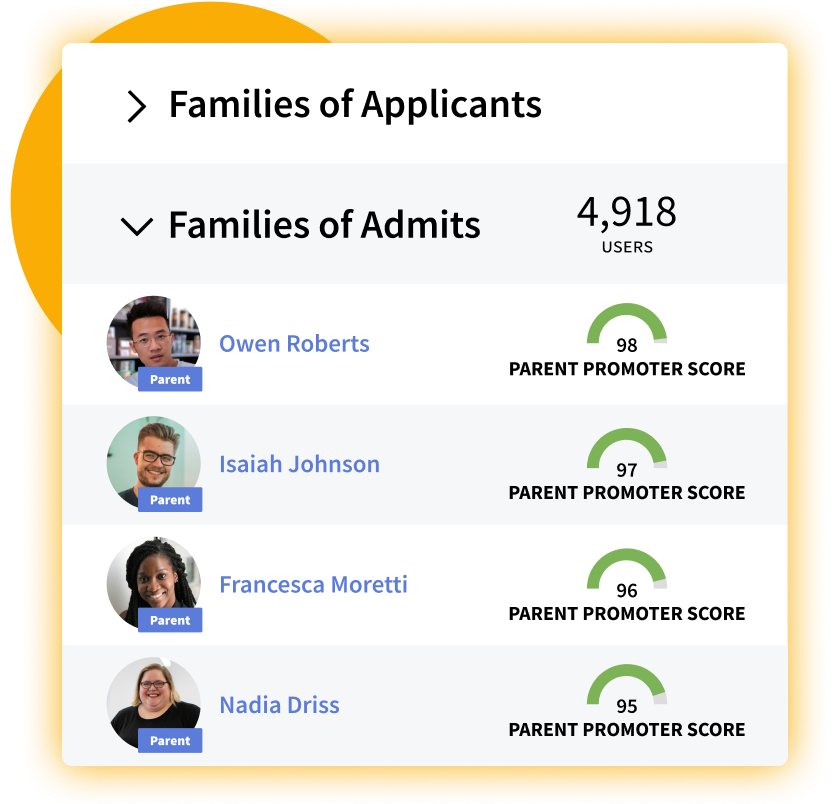
CampusESP’s Parent Promoter Score™ helps institutions be more strategic with parent data. It’s a score between 0-100 that ranks parents based on engagement actions, including email opens, content clicks, portal logins, account registrations, and more.
Parent Promoter Score™ elevates the most engaged parents, so you can focus on the students most likely to move through the funnel – or the ones that need a little more support. The score is often used for enrollment modeling, considering parents in the top quartile of engagement are 3x more likely to have a student enroll.
Enrollment leaders are using Parent Promoter Score to identify students who may be gaining momentum, families who may need more support, and opportunities where a timely nudge could help move the decision forward.
Here are five ways to use it, from quick wins to more advanced enrollment modeling.
5 ways enrollment leaders are using Parent Promoter Score
1. University of the Pacific goes all-in on engaged families that haven’t converted … yet
If a parent frequently engages with your content, they are considering sending their student to your institution. You can think of a high Parent Promoter Score as a high intent to convert to the next stage of the funnel.
However, when a parent has a high score, but their student hasn’t yet applied, deposited or enrolled, these are the families to double down on. CampusESP allows you to continually nudge these families with automated campaigns.
What to try: Pull high-PPS families whose students have not taken the next step that matters most this week. Send a focused message about that action, whether it is depositing, finishing financial aid steps, scheduling a visit, or completing an admitted student checklist.
2. University of Wisconsin-Milwaukee focuses on families “on the fence”
While the most engaged families are low hanging fruit, some find it even more impactful to focus on families that haven’t made a decision yet. By devoting more counselor resources to these families or tweaking the messages you send them, you have an opportunity to sway their decision.
CampusESP makes it easy to personalize content based on Parent Promoter Score. You can tailor your communication towards winning over less engaged parents, while affirming enrollment decisions for more engaged parents.

“I’m a big believer in the power of Parent Promoter Score. This data shows us which students are likely to enroll. It also helps us understand which families are ‘on the fence’ – and where my team can make an impact to grow our incoming class.”
What to try: Create two versions of a yield message. Send more engaged families a direct next-step nudge. Send less engaged families content that answers the questions that may be slowing them down, such as cost, value, support, or fit.
3. Juniata helps admissions counselors prioritize outreach.
With an endless list of students and limited cycles, admissions counselors should be strategic about which students they spend time on. Parent Promoter Score helps counselors focus their efforts.
Parent Promoter Score signals which families need more counseling, which families could use an extra nudge to visit, apply, or deposit – and which parent is the bigger supporter (AKA, the better one to call). With CRM integration, it’s easy to get the data out of CampusESP and into the hands of counselors.

“Parent Promoter Score helps us identify interest in Juniata. We’ve had multiple instances of “stealth” interest – where students have never engaged with us, but we see a high Parent Promoter Score, our admissions counselors give the parent a call, and they have a great conversation to move the process forward.”
What to try: Build a counselor call list around a specific PPS scenario, such as high family engagement and no deposit, high family engagement and low student activity, or admitted students with engaged families who have not registered for a visit.
4. Beloit College pulls Parent Promoter Score into enrollment modeling.
Our research shows that students with engaged parents are more likely to apply and more likely to yield. To measure these results for your own institution, CampusESP provides reports that demonstrate how higher Parent Promoter Scores are associated with higher funnel conversion rates.
Some institutions go deeper and build custom predictive models for their unique population. These models offer a target score for each funnel stage, which serves as an indicator of whether they’re on track to meet their target numbers for each enrollment stage.

“Parent Promoter Score is a core part of our yield model – along with campus visits, FAFSA submissions, and a student propensity score. At the top of our funnel, we consider a high Parent Promoter Score a trigger to move a student from prospect to inquiry. At the bottom of our funnel, a high score is correlated with deposits.
Parent Promoter Score also guides our outreach strategy – If a parent has a high score, we know they’re interested, so we send them print mailings and may offer a financially supported campus visit.”
What to try: Look at whether student and family signals are aligned. When both are highly engaged, that may point to strong intent. When the student is engaged but the family isn’t, families may need more support around cost, value, distance, or fit. When the family is engaged but the student isn’t, that may be a sign that a counselor should reach out.
5. Gettysburg brings parent data into Slate for easy visibility
For more advanced teams like Gettysburg College, using Parent Promoter Score goes beyond building a list of families to contact.
Gettysburg is building family engagement into the way their enrollment team sees, reports on, and acts on student interest. Sarah Walter Kotlinski, Executive Director of Platforms, Analytics, and Innovation, explained the challenge clearly: CampusESP engagement data is tied to the adults in a student’s support network, but enrollment teams usually work from the student record.

“This score gives you a lens into how families are engaging and thinking about your institution from an enrollment perspective. You might have a student who doesn’t look particularly engaged, but the family is. And that may be a student worth spending more effort on.”
Gettysburg solves for that by translating parent-level CampusESP data into a student-level field in Slate. Their “CampusESP Status” field combines whether a family member has registered with that family’s Parent Promoter Score band, such as “Registered, Top Quartile.” That gives staff a quick read on whether a student has an engaged family behind them without digging through multiple relationship records.
For the Gettysburg team, PPS is not sitting off to the side as a parent engagement metric. It is part of the student record, where staff can see it during calls, leaders can include it in yield reports, and teams can segment students for more focused outreach.
They also take the signal one step further by thinking about trajectory. Instead of only storing today’s PPS, Gettysburg recommends storing PPS over time so the team can see whether family engagement is rising, holding steady, or dropping sharply. That trend can help them spot changes in interest before a student melts or chooses another institution.
What to try: This is probably the point where it is completely fair to get in contact with a CampusESP experts.
How to get started
To get the most out of Parent Promoter Score, we recommend exporting the data from CampusESP back into your CRM – where most of your enrollment team works on a daily basis. CampusESP supports integration with Slate, Salesforce, TargetX, Ellucian Recruit, and other major CRMs.
If CRM integration is not an option for you, CampusESP offers automated, recurring exports, which makes it easy to email parent engagement data to any relevant stakeholders on campus.
With only a three-week implementation, CampusESP can jumpstart your parent communication and provide meaningful parent data in no time.