
The engagement advantage in admissions

At the University of Wisconsin-Milwaukee (UWM) and the University of Mary Washington (UMW), enrollment teams are looking at yield through a wider lens.
They are not only asking whether students are opening emails, visiting campus, or joining a student community. They are also looking at what families are reading, where parents are showing interest, and which admitted students may need a clearer next step.
At UWM, students with engaged parents had a 16-point higher yield rate than the institutional average. At UMW, students with engaged parents had an 18-point higher yield rate than the institutional average. And when student community engagement was added to the picture, both institutions saw another strong signal of intent.
During a conversation with Chris Brundidge, Director of the Office of Student Enrollment Communications at UWM, and Sarah Lindberg, Director of First-Year Admission at UMW, both shared how their teams use CampusESP for family engagement and ZeeMee for student engagement to help students see themselves on campus, help families understand what comes next, and help counselors focus outreach where it can make the biggest difference.
And yes, UWM and UMW are two different schools. The names are close. The strategies are even closer. (Skip ahead and listen to the conversation here.)
Use family engagement data to identify intent signals
What makes UWM and UMW’s approach so strategic is that engagement is not just a gut feeling. Both teams are using real signals to understand which students and families are leaning in, where confusion may be building, and where a timely nudge could help.
CampusESP’s Parent Promoter Score helps teams understand how families are interacting with the portal, newsletters, posts, and other content.
Chris said UWM brings those engagement signals into Slate alongside other student data. That matters even more as direct admit increases application and admit volume.
“With direct admit, having so many admitted students, our recruiters really need a device to whittle down and segment to students that are more realistically choosing to enroll,” Chris said.
UMW is using a similar idea, especially for what many enrollment teams call the “murky middle.” Sarah’s team compares family engagement with student engagement in ZeeMee, then uses that fuller picture to decide where support may be needed.
A parent who is not highly engaged may not be uninterested. They may be commuting long hours, unsure what to look for, or unable to participate in every step. That signal helps the team ask a better question: does the student need more direct support?
“Let’s sit down and have a cost conversation,” Sarah said. “We would love for your parents to be a part of that, but if you need to take ownership over that, we can use this information to help us understand where there may be support or where there might not be support.”
Make cost and ROI easier for families to understand
When CampusESP looked at the most engaged-with family content for both campuses, the same theme kept rising to the top: cost.
At UWM, a financial aid and scholarships article was the third most viewed article in the portal. At UMW, a financial aid article was the most viewed article in the portal. Sarah said three of UMW’s top four all-time posts are tied to financial aid and paying for college. The fourth is accepted student information, which likely includes financial aid and scholarship details too.
“Families really are searching for information about costs and how to pay for this investment that they’re making in their student,” Sarah said.
That lines up with what CampusESP is seeing nationally — 65% of families said final net cost after aid and scholarships is the most important factor in choosing a college.
UMW uses CampusESP drip posts to surface financial aid content as families move through the funnel. The team also points families back to those posts through other messaging and promotes family webinars with the financial aid team, including sessions that walk families through the FAFSA, merit scholarships, and payment plans.
For Chris, the ROI conversation is especially important for first-generation families and families who may find the financial aid process overwhelming.
“Even navigating our website can be daunting,” he said. “Having drip posts set up to distill this information across a period of time helps families feel on top of what they need to do, and most importantly, not get overwhelmed by trying to find all of this information themselves.”
Turn admitted student excitement into clear next steps
Admission is exciting, but it also creates a new wave of tasks. Activate the student account. Submit housing forms. Register for orientation. Review scholarship information. Accept or decline the offer. Join the student community.
Both UWM and UMW use CampusESP to turn that stage into a clearer roadmap for families. Their accepted student and next steps posts are among the most viewed articles in both portals.
Sarah said UMW created those posts intentionally because families often need a reference point they can return to.
“Being able to give that parent that same checklist in a place where they could print it out and put it on the refrigerator is really important,” she said. “Sometimes our reminders don’t necessarily get action on students, but parent reminders can sit there and bug them at the dinner table.”
That is where the CampusESP Admissions Dashboard becomes especially useful. With CRM integration, families can see admissions checklists, scholarship information, housing details, cost of attendance, and other student-specific information directly in the family portal.
At UWM, that means mapping the Slate student checklist into the Panther Family Portal.
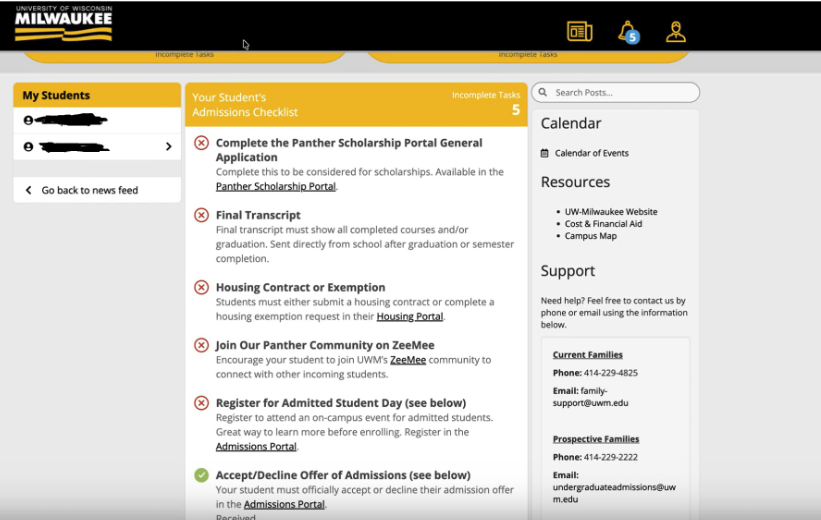
“When we’re going after students and saying, please do your next steps, please do your next steps, we’re sending all of these emails,” Chris said. “What if we just sent mom and dad or guardian a message and said, ‘Hey, did you know your student needs to take next steps?’ They log into their portal and they can see exactly what the student sees.”
It also keeps families from needing access to the student’s admissions portal login, which is a win for students, families, and every IT team involved.
Build belonging before students arrive
While CampusESP helps families understand the process, ZeeMee gives students a place to build community before campus. For Chris, that sense of belonging is part of the enrollment decision.
“Students need to feel a sense of belonging on a campus that they’re committing to,” he said. “Students that can see that vision the clearest, it’s easier for them to commit.”
UWM leans on student influencers, many of whom are campus ambassadors, to show prospective students what life on campus actually feels like. Chris said the most successful content is often not the polished marketing video. It is the authentic student moment.
“One of the most successful posts an influencer made was just a landscape shot of them at a picnic table in the park, saying they were decompressing after a final exam,” he said. “Students just want to be able to see and connect and contextualize what their experience will look like.”
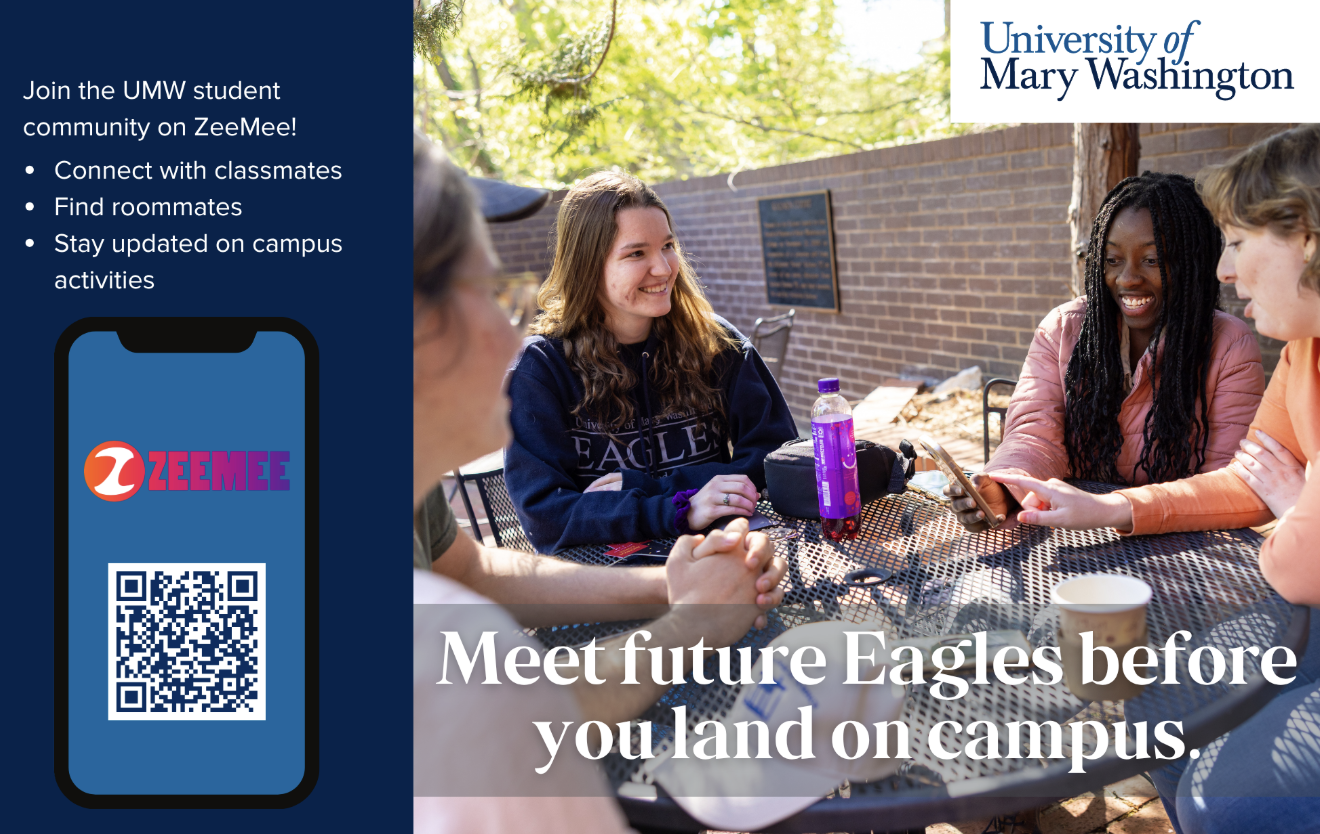
UMW builds ZeeMee and CampusESP into the admissions process early. Sarah’s team promotes both at college fairs, high school visits, information sessions, open houses, and admitted student days. They use postcards with QR codes, include both platforms in counselor presentations, and make joining the student community part of the admitted student checklist.
“We really push ZeeMee and CampusESP both at the start of their life cycle,” Sarah said. “Students who are able to make connections before they get to campus are then going to be more likely to enroll.”
Be ready to communicate when something goes wrong
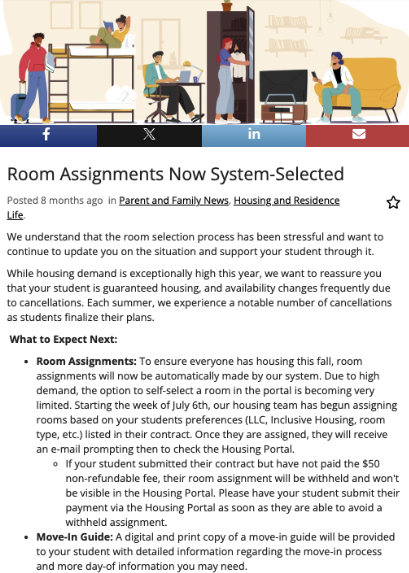
Not every admissions or enrollment process goes perfectly. UWM had a housing room selection change that created confusion for families. Chris was direct about it: “It almost worked. It kind of worked, and then we had some issues.”
The Panther Family Portal gave the team a clear way to explain what happened, what was changing, and what families needed to do next. The post became the second most viewed article in the portal.
“That would have been really difficult to do without our family portal,” Chris said. “It’s another opportunity for us to be transparent and share information, get it to where it needs to go, and most importantly, talk about how we’re remedying the situation.”
The engagement advantage
The clearest takeaway from UWM and UMW is that engagement is about knowing where attention, interest, confusion, and momentum are showing up for families.
That is the engagement advantage Chris and Sarah described. Not one big campaign. Not one perfect message. A connected view of students and families that helps enrollment teams make the path from admitted to enrolled clearer, more personal, and easier to act on.