
How South Alabama connected family engagement strategy across the student lifecycle

Parent and family communication was happening across the University of South Alabama, but families were not always getting a clear, consistent path through the student journey.
Different offices were reaching families with their own messages, while enrollment was doing strong one-on-one work with parents without a consistent way to continue that communication over time. And because South Alabama wanted students to build independence, families were sometimes left with gaps they tried to fill on their own.
With CampusESP, South Alabama brought those efforts into one connected family engagement strategy spanning from inquiry through graduation. Ashley Suggs, University Registrar and FERPA Compliance Officer; Stephanie Durkac, Assistant Director of Marketing & Communications in Enrollment Services; and Dallas Schmidt, Associate Director of Student Academic Success, worked together to create a more seamless experience for families.
For the Fall 2025 cohort, students with an actively engaged family member in CampusESP yielded at a rate 23.5 percentage points higher than the institutional average. Orientation reservation confirmations were also up 276% year over year. And more than 2,000 FERPA connections were created, with about half initiated by students.
But the bigger story is how South Alabama got there. Read below or watch the full conversation here.
Fix the family experience across departments, not one message at a time
South Alabama’s starting point will sound familiar to a lot of campuses. “We had people communicating in different departments with parents and families,” Stephanie said. “Each department or office seemed to have their own messaging of what it was that they wanted to get out to parents.”
Enrollment Services was doing a strong job with one-on-one conversations, but Stephanie saw an opportunity to make the experience more consistent. Families needed more than individual touchpoints. They needed a communication path that matched the stage their student was in.
That shift required a mindset change. Like many enrollment teams, South Alabama wanted students to build independence. But in trying to avoid over-involving parents, they realized they had created gaps families were filling on their own.
“We were kind of leaving a lot of holes in our parent information,” Stephanie said. “We thought that we were doing the right thing by allowing their student to become more responsible. But by doing that, we were definitely leaving a lot of resources on the table.”
Those gaps showed up in the places every campus knows too well: unofficial Facebook groups, outdated deadlines, incorrect phone numbers, and families trying to make decisions with incomplete information.
CampusESP for Student Enrollment gave South Alabama a way to replace that patchwork experience with a clearer path. Families could receive stage-specific emails, checklists, reminders, and next steps based on where their student was in the process. Instead of assuming students opened every email, understood every deadline, and relayed every detail home, USA equipped families to reinforce the right messages at the right time.
Repurpose student communications to scale family outreach
One of the most practical takeaways from South Alabama’s approach is that family engagement did not require building a brand-new communication strategy from scratch.
Stephanie explained that USA already had communication flows in place for prospective students. Before CampusESP, some parent communication was closer to copying families on student-facing messages, and only when the student had provided a parent email address.
CampusESP helped the enrollment team scale that work by turning existing student communications into family-ready guidance. Instead of rewriting every message manually, USA could use built-in AI tools to adapt student-facing content for a parent audience, keeping the same important milestones while changing the framing.
“You can take your student communication flow that you already have, and you can flip it so that it turns into parent communication,” Stephanie said. “You can hit all the same points, but you just do it for a different audience.”
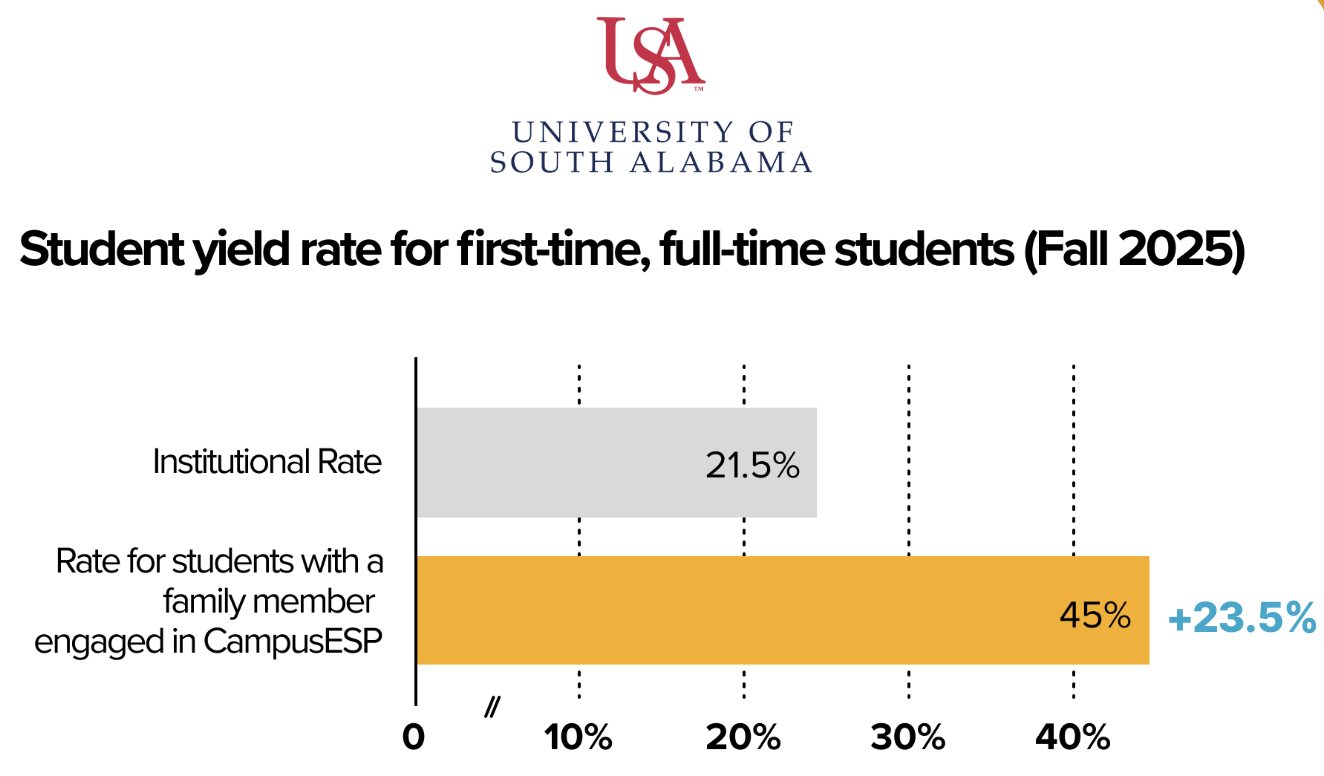
At South Alabama, those family nudges added up. For the Fall 2025 cohort, students with an actively engaged family member in CampusESP yielded at a rate 23.5 percentage points higher than the institutional average.
Ask families what they need, then build content around it
Once students enroll, family questions do not stop. They shift from admissions steps to the day-to-day questions that affect student success, like advising, grades, housing, career readiness, and campus involvement.
That is where Dallas and the Student Academic Success team leaned into CampusESP for Family Communication as more than a place to send updates. When families created their South Alabama Family Connection accounts, USA could better understand what topics they cared about and use that insight to guide current-family content.
“We’re able to tailor our content based on what parents are interested in,” Dallas said. “Trending, it’s been a lot of career development because parents, of course, want to know that their students are getting jobs when they’re done.”
That interest also matched what CampusESP was seeing more broadly: 88% of families rank career services and job placements as 'crucial,' yet only 34% are satisfied with the communication they receive. So USA turned that insight into practical guidance, sharing career development events with families and explaining how they could encourage their student to attend without taking over.
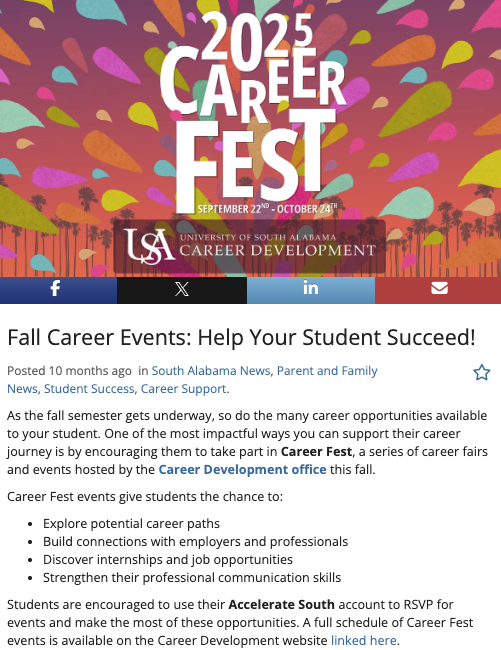
3 posts of Top 30 clicked articles were about Career Support (Career Fair, Fall Events, etc.)
The same approach is shaping future content around housing and student involvement, two other areas families showed interest in. USA also started a webinar series based on the resources families wanted to better understand, beginning with career development and expanding into other student support topics.
For Dallas, the value was not just having more content. It was having a better way to help families support students through a “supportive lens.” After grades posted, for example, USA shared guidance on how families could talk with their student about academic progress, encourage them to use campus resources, and support them after the student took the next step.
Reframe FERPA as a partnership, not a roadblock
As University Registrar and FERPA Compliance Officer, Ashley Suggs was used to giving what she called the “FERPA speech” at parent orientation. The message families often heard was simple: your student is in college now, the rules have changed, and we cannot talk to you.
“That was the message that families were hearing,” Ashley said. “Not that we’re here to help, we’re here to help your students, we’re here to help you. It made them feel more like, ‘We want your money, but we don’t want to talk to you.’”
CampusESP for FERPA Management helped South Alabama change the tone of that conversation. Instead of leading with what families could not access, Ashley could show them a secure process for partnering with their student. Students and families can initiate a FERPA connection, and students stay in control of what they choose to share.
Since launching in 2025, South Alabama has built more than 2,300 FERPA connections, with nearly half initiated by students and a 93% approval rate. USA promotes the process through parent orientation, its website, and parent-facing materials, giving families a clearer path than calling around campus or relying on their student’s login.
That shift changed how Ashley uses orientation. Now, she asks families to help reinforce the same messages South Alabama is already giving students: meet with your advisor, review your degree audit, talk to financial aid, connect with scholarship services, and follow through before a small issue becomes a bigger barrier.
“So it’s more of, these are the things that you can do to help reinforce our messaging and help set your student up for success versus having the big scary FERPA talk with parents,” Ashley said.
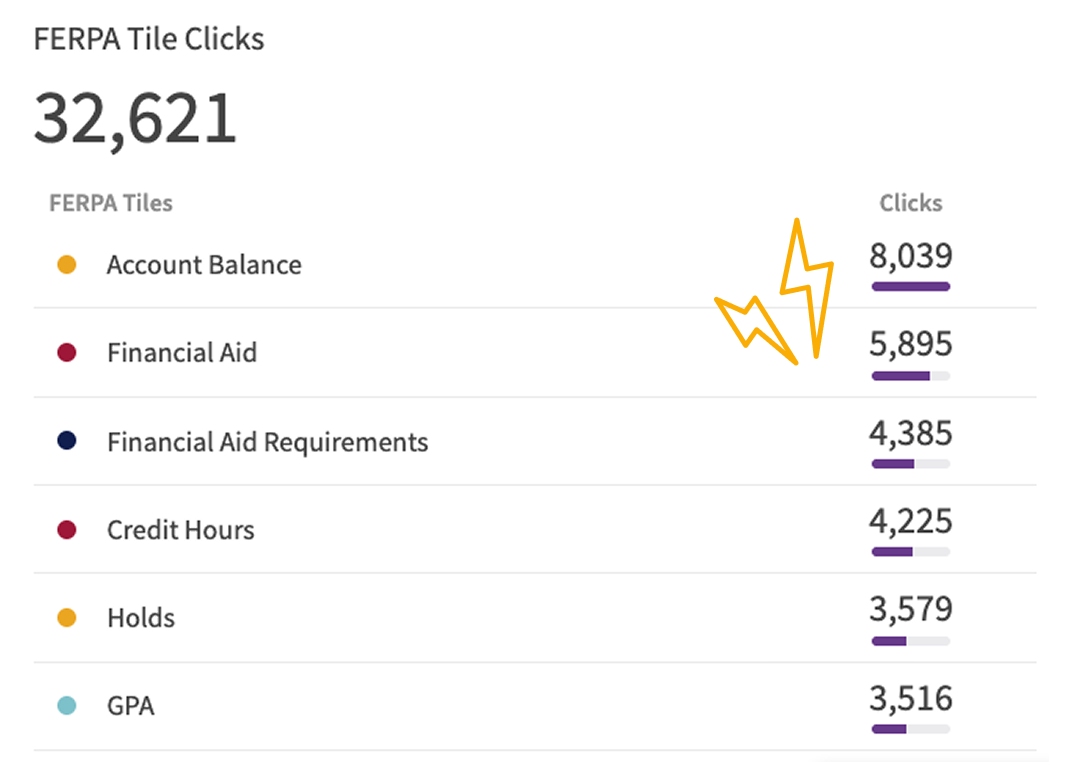
South Alabama’s data also challenged a common assumption. Families were not mainly clicking into grades. More than half of USA’s FERPA tile clicks were on financial aid and billing information, including account balances, aid requirements, and other details that can affect whether a student stays on track.
When families have secure visibility into the administrative steps that can slow students down, they can help students ask better questions, contact the right office, and resolve issues earlier. CampusESP’s retention research found that students whose families had access to student progress data had retention rates 6.9 percentage points higher than students without engaged parents, with even larger gains for Black and Hispanic students and first-generation students.
Make family engagement part of the work already happening
South Alabama’s approach works because it is connected, but not overcomplicated. The team met regularly during implementation, but today, collaboration happens more organically through the committees, initiatives, and everyday conversations they are already part of.
“It’s really easy for me to grab Dallas and say, ‘Hey, we need to remind families about this,’ or Stephanie might say, ‘Ashley, when are winter grades rolling?’” Ashley said. “It’s been much more organic that we’re having these conversations when we’re seeing each other, usually for other reasons.”
That may be the most realistic model for many campuses. Family engagement does not always need another standing meeting. It needs enrollment, registrar, student success, and other campus teams asking the same question more often: how will families understand this, and how can they help their student take the next step?
For South Alabama, CampusESP became the shared place to act on that question.